Biology Together · Unit 7: Seasons and living things
Adopt a Tree
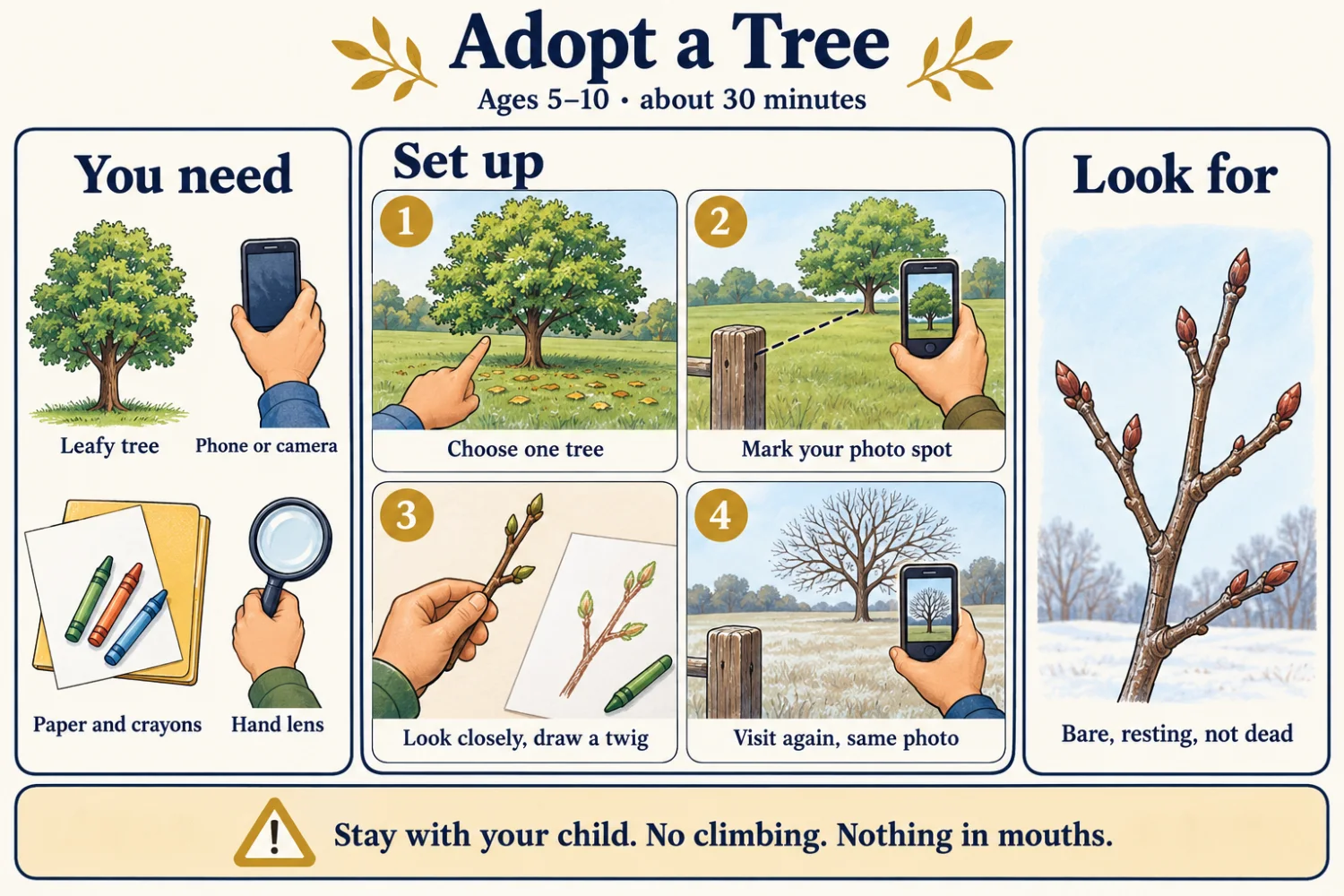
You and your child choose one tree near home or school and visit it about once a month for a year, taking a photo from the same spot and drawing what you see. Your child finds out that the tree changes in the same order every year, that it rests in winter instead of dying, and that next spring's leaves are already waiting in its buds.
Watch first Set Up: Adopt a Tree · 1:08
Read the transcript of “Set Up: Adopt a Tree”
Film transcript: Set Up: Adopt a Tree
A tree with no leaves in winter is not dead. It is resting. Visit one tree all year, watch the seasons come in the same order, and find the buds already holding next spring's leaves. You need one tree that loses its leaves in fall, one you can reach safely and have permission to visit. Bring a phone or camera and paper. Stand ten to twenty steps back, so the whole tree fits in the photo. Pick a landmark, and take every photo from there, facing the same way. Your child predicts first. Visit about once a month for fifteen minutes. Notice the weather and look for animals. In much of Virginia, buds swell and open in March and April. Dates vary. Compare each new photo with the last one.
A bare winter twig still has buds, so the tree is resting, not dead. Stay with your child at the tree on every visit. Feet stay on the ground, with no climbing, and nothing from the tree goes in a mouth.
Before you start
- Hands-on time
- About 30 minutes, then a 15-minute visit about once a month (or once a season) for a year
- Where
- Outdoors
- Ages
- 5 to 10, with an easier and a harder version below
- Grown-up
- Stay with your child at the tree on every visit. You choose the tree and check the trunk and the ground around it before the first visit.
What you need
- One tree that loses its leaves in fall (such as a maple, oak, dogwood, tulip poplar or fruit tree) that you can reach safely and have permission to visit
- A phone or camera
- Paper, pencils and crayons, and a folder to keep every visit together
- A hand lens (optional; see the safety note)
- For ages 8 to 10: a ball of string, a ruler or tape measure, and a weather website or app
- Paper and a pencil, or the printed observation sheet below
Virginia science standards SOL 1.7 cSOL 1.7 aSOL K.9 bSOL K.10 aSOL 2.7 a
The big idea
Children walk past the same trees every day and rarely notice them change. Adopting one tree slows that down. Your child visits the same tree again and again, from the same spot, and the changes pile up in the photos and drawings.
Many Virginia trees, such as maples, oaks, dogwoods and tulip poplars, are deciduous: they lose their leaves each year, mostly in fall, and grow new ones in spring. The tree does not die in winter. It goes dormant, which means it is alive but resting, with most growth paused. Many of next year’s leaves and flowers are already packed inside buds, small wrapped bundles on the twigs, before the old leaves fall.
These changes follow the seasons, and the seasons come in the same order every year. Shorter days and cooler weather in fall start leaf drop. Warmer days in spring wake the buds. In grade 1, children notice budding, growth and losing leaves and link them to temperature and light. Grade 2 adds the idea of dormancy.
What to do
- Choose a tree. Pick one that loses its leaves in fall, not a pine or holly. In fall, look for leaves on the ground beneath it. In winter, look for bare twigs with buds. Let your child name the tree if they like. With a class, one schoolyard tree for everyone works well.
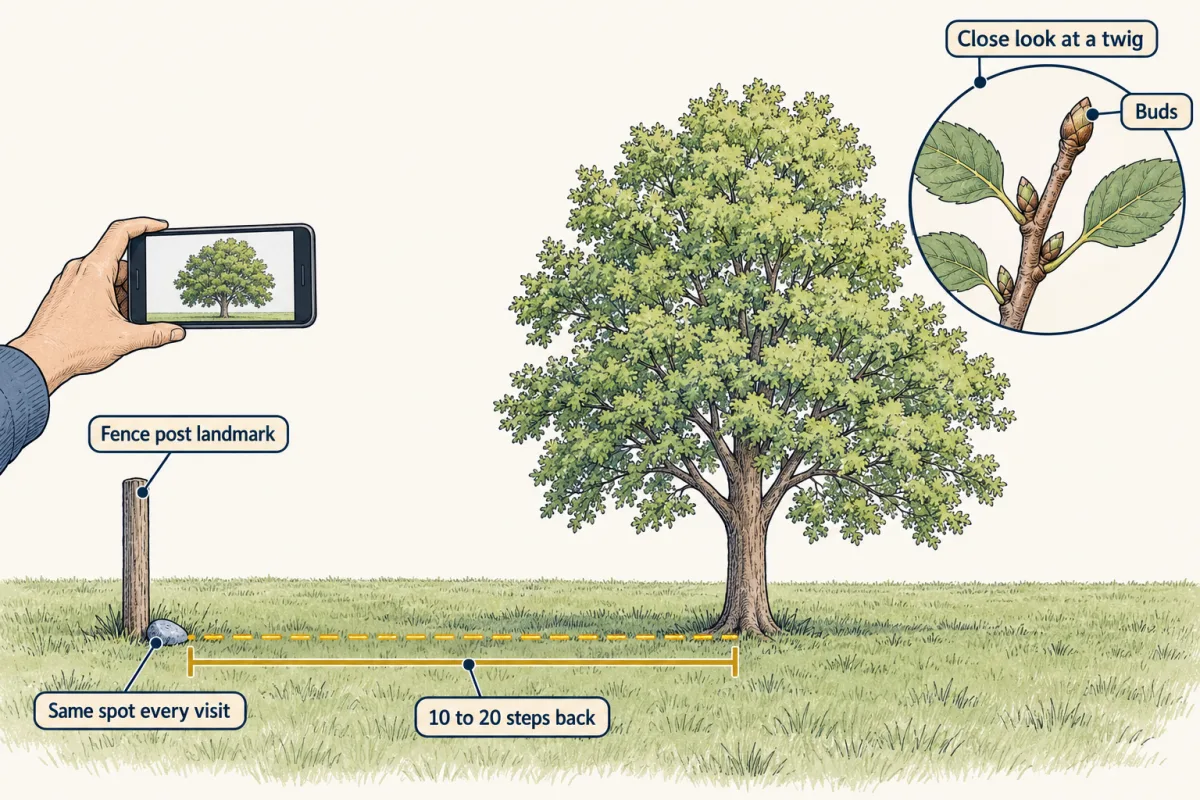
- Mark your photo spot. Stand 10 to 20 steps back, so the whole tree fits in the photo. Choose a landmark, such as a fence post or a sidewalk crack, and take every photo from there, facing the same way.
- Predict first. Before the first look, ask, “What do you think this tree will look like next month? In winter?” Your child draws or says a prediction. Keep it in the folder.
- Take a close look. Spend about 10 minutes at the tree. Look at the bark, a low twig and a few leaves. Find the buds at the tip of a twig and where each leaf joins it. Your child draws one twig or leaf up close.
- Notice the weather and the light. Is it warm or cold? Sunny, cloudy or rainy? Do you need a coat? Is it dark by dinnertime? Record the answers in words or simple pictures.
- Look for animals. Watch for birds, squirrels, insects, nests, holes and chewed leaves. Look, but don’t touch. Ask, “What is this animal using the tree for, food or shelter?”
- Visit again. Return about once a month for a 15-minute visit. Take the same photo, draw the tree, and fill in a row of the sheet. Before each visit, ask your child to predict one change.
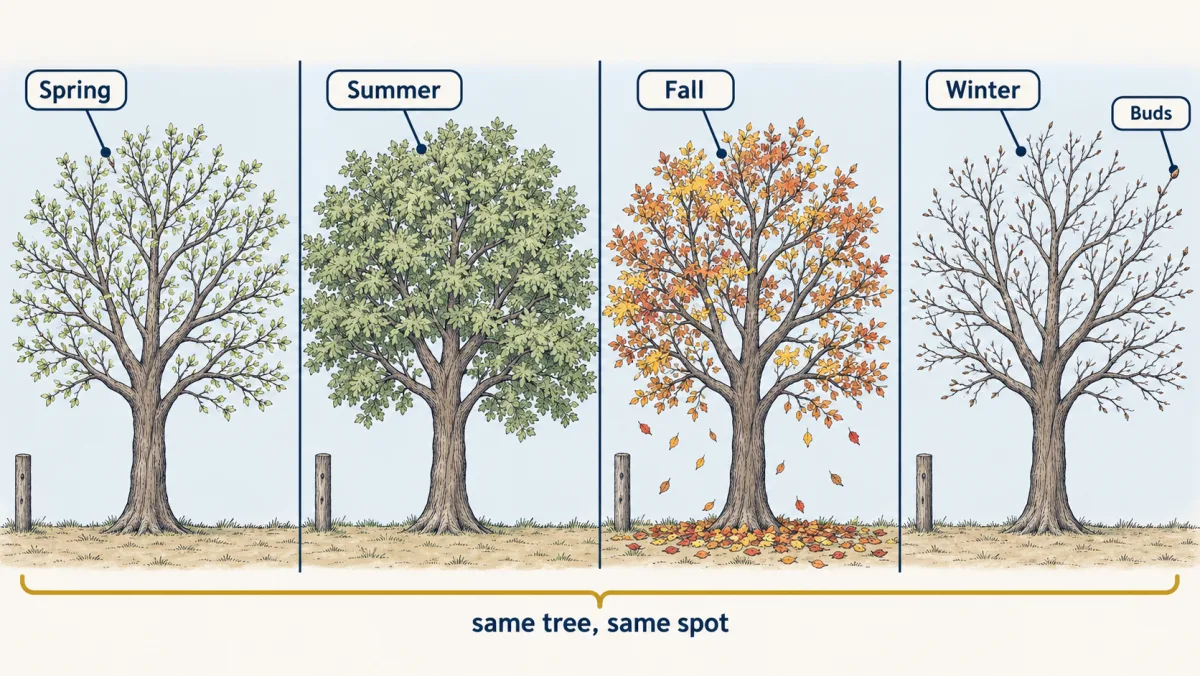
- Know what to expect. In much of Virginia, buds swell and open in March and April. Leaves are full from May to September. Colors and leaf drop come mostly in October and November, a little earlier in the mountains. Most trees stay bare from December to February, though some oaks and beeches, especially young ones, hold dry brown leaves into late winter. Dates vary by tree and by year.
- Make a four-season poster. Once you have a visit in each season, put one photo or drawing from each in order: spring, summer, fall, winter. Ask, “What happens next?”
Questions to ask while you do it
Ask your child to guess first, then check.
- “I wonder what is inside this bud. What do you think will come out?”
- “What do you think the tree will look like on our next visit?”
- “Which leaves will change color first, the ones at the top or the bottom?”
- “Is it getting dark earlier or later than last time? What might the tree do about that?”
- “What animals do you think use our tree in winter?”
- “What do you think will happen if we come back on the same day next year?”
What children often think
-
A child might say “The tree died. It has no leaves.”
You could try Look closely at a bare twig together. Find the buds and ask, "What do you think is inside?" Watch the same twig in spring. The tree is resting, not dead, and next year’s leaves are folded inside those buds.
-
A child might say “Leaves fall because it gets cold.”
You could try Cold is part of it. Ask, "Is it getting dark earlier now?" Trees respond to shorter days as well as cooler weather, and many start dropping leaves before the first frost. Check your sheet: when did the leaves start falling, and how cold was it?
-
A child might say “Evergreen trees never lose their leaves.”
You could try Look under a pine tree in the fall. You will often find a carpet of brown needles. Evergreens drop old needles or leaves a few at a time. Pines often drop their inner needles in fall. They always keep enough green ones to stay green all year.
-
A child might say “The tree is the same every time we come.”
You could try Put this month’s photo next to last month’s and ask, "Can you find three differences?" Some changes are slow, like swelling buds. Lining the photos up in a row makes slow changes easier to see.
Why it works
In winter, broad thin leaves cost a tree more than they give. They lose water through tiny pores, and cold or frozen ground makes that water hard to replace. Freezing can also damage them. Dropping them lets the tree wait out the cold.
The tree does not simply lose its leaves. As nights grow longer and temperatures fall, it stops making the green pigment chlorophyll and pulls some nutrients back into the twigs. A band of cells at the base of each leaf stalk, the abscission layer, weakens until the leaf breaks off. A seal forms over the scar. The exact mix of signals differs between kinds of trees.
Buds form in summer and wait through winter, many tightly wrapped in scales. After enough cold, warm spring days start them growing. The tree also feeds and shelters animals year-round: squirrels nest in it, birds eat its seeds, and insects eat its leaves.
Easier and harder
Ages 5 to 7
Visit four times, once in each season. At each visit, take the photo, draw the tree, and mark the weather with a picture: sun, cloud, raindrop or snowflake. Add “coat” or “no coat.” Your child describes the tree in one sentence, which you write down. Make the poster with four big boxes, one for each season.
Ages 8 to 10
Visit monthly. At about your child’s chest height, wrap string around the trunk, mark the string where it meets its end, and measure the string up to that mark in cm. Mark the spot so you measure there every time. Trunks grow slowly, so “no change” may be a real result. From a weather site, record the high temperature and the hours from sunrise to sunset. In Virginia, day length runs from about 9 and a half hours in late December to almost 15 hours in late June. Graph day length by month, then mark when the leaves changed.
If it doesn’t go as planned
If the photos are hard to compare, you probably shot from different spots. Mark the spot with a painted stone or a note on your phone. If the tree stays green all winter, it may be an evergreen, such as a holly or a southern magnolia. Keep it as a comparison and adopt a second tree. If you miss a month, just carry on. Even four visits a year show the pattern.
Observation sheet
Observation sheet
My tree visit
NameDate
Fill in one row each time you visit your tree.
| Date | Weather: warm or cold? sun or rain? | Leaves: buds, green, colors, falling, or none? | Animals I saw |
|---|---|---|---|
One thing that changed since last time:
biochemistrypedia.com · Biology Together
Finish line
Test yourself
4 questions
Practice and MCAT-style, with explained answers.
Next · Lesson 26
Sleep, Travel or Stay?
Where do hummingbirds go in winter, and why does a cardinal stay? A sorting game and a window watch find out.
Continue →