Biology Together · Unit 6: Food chains, soil and decomposers
Who Eats Whom?
You and your child make picture cards for a Virginia meadow food chain and a Chesapeake Bay food chain, line them up with arrows, then join them into a web with a ball of yarn. Your child finds out that energy starts with the sun and that taking away one living thing tugs on many others.
Watch first Set Up: Who Eats Whom? · 0:47
Read the transcript of “Set Up: Who Eats Whom?”
Film transcript: Set Up: Who Eats Whom?
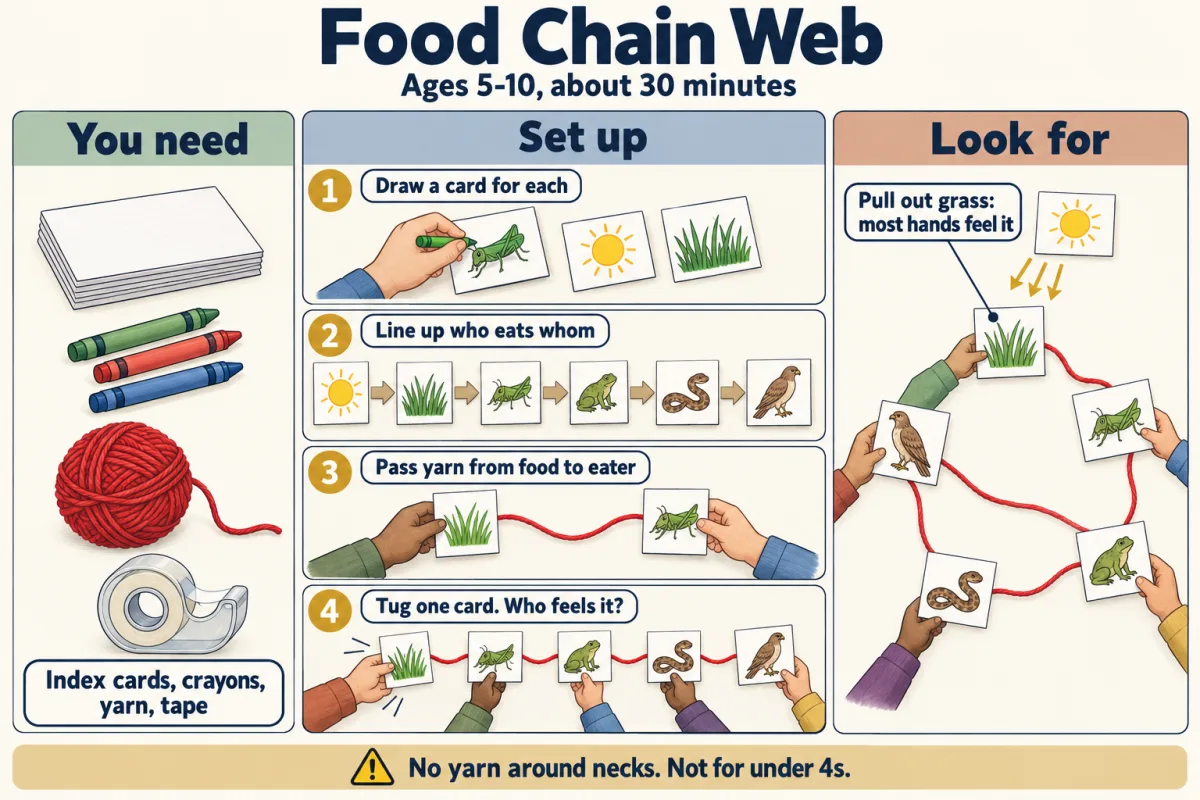
You need twelve to eighteen index cards, crayons or markers, and a ball of yarn. Draw one card each for sun, grass, grasshopper, frog, snake, and hawk. Line them up by who eats whom. Each person holds one to three cards. Start at the grass and pass the yarn from each food to its eater. Pull one card out and give the yarn a small tug. Anyone who feels it raises a hand. Take out the grass, then ask who loses their food first. Stay with your child the whole time. Never put yarn around a neck, and do not wrap it tightly around fingers or wrists. Nobody walks while holding yarn.
Before you start
- Hands-on time
- About 30 minutes
- Where
- Indoors or outdoors
- Ages
- 5 to 10, with an easier and a harder version below
- Grown-up
- Stay with your child the whole time. You do any cutting, and you watch the yarn during the web game.
What you need
- 12 to 18 index cards or squares of paper
- Crayons or markers
- A ball of yarn or string
- Scissors (for the adult)
- Tape or paper clips
- A clear space on the floor or a table
- Paper and a pencil, or the printed observation sheet below
Virginia science standards SOL 3.5 bSOL 4.3 aSOL 4.3 bSOL 4.3 cSOL 4.7 c
The big idea
Children already know who eats what. A bird pulls up a worm. A cat stalks a mouse. This activity turns those scenes into a chain and then a web.
Every chain in this activity starts with the sun. Producers are living things, like grass and algae, that make their own food using sunlight. Consumers are living things that eat other living things. Some eat plants, some eat animals, and some eat both. Decomposers, such as mushrooms and bacteria, break down dead plants and animals.
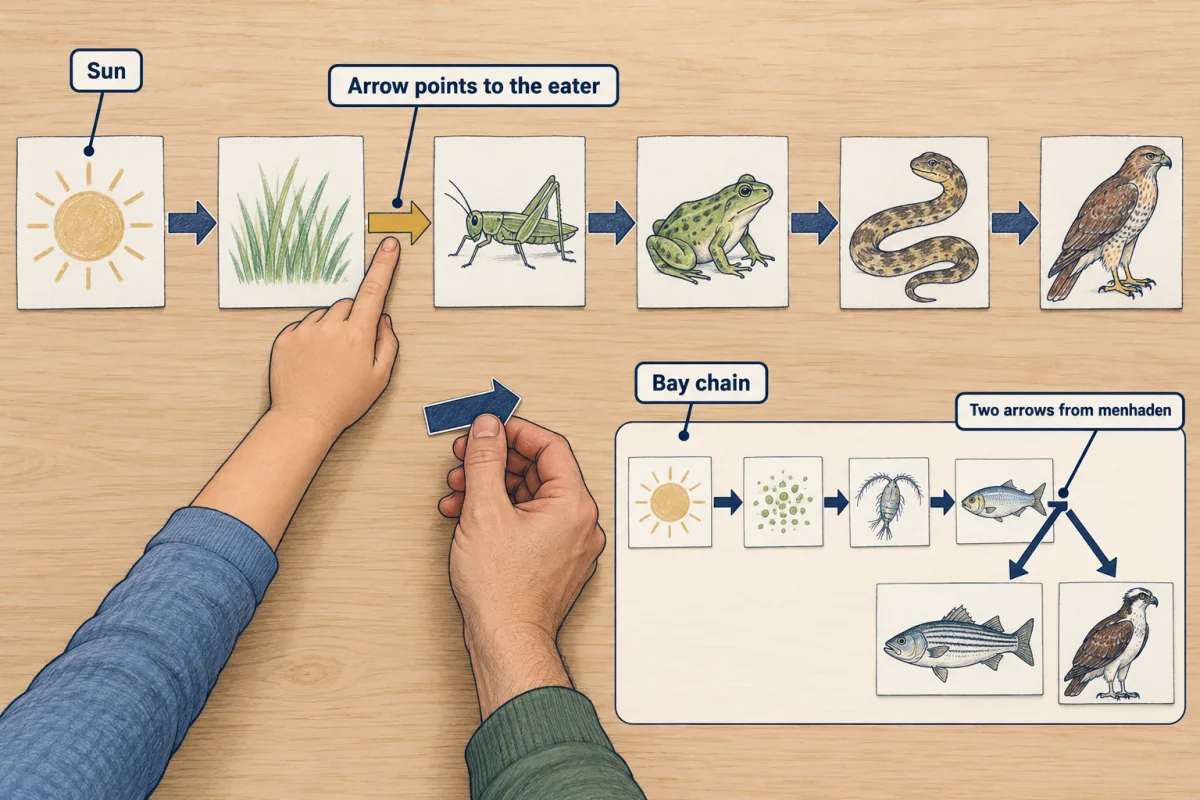
In a food chain, each arrow points to the one doing the eating. That shows which way the energy moves. A food web is many food chains that overlap. Pull one card out and many others feel it.
Virginia’s grade 3 standard asks children to build a food chain and point the arrows correctly. In grade 4, children build food webs for places near them and see how a frog’s food changes as it grows. Food pyramids are not part of the grade 4 standard.
What to do
- Make the land cards. Help your child draw one card each: sun, grass, grasshopper, frog, snake, hawk. Write the name under each picture.
- Line up the land chain. Ask, “Who eats whom?” Let your child order the cards on the floor. Then draw arrows on scraps of paper and place one between each pair. Ask, “Where does the grass go when the grasshopper eats it?” The arrow points to the grasshopper.
- Make the Bay cards. Draw sun, phytoplankton (tiny floating algae that use sunlight), zooplankton (tiny floating animals), menhaden (a small fish that strains plankton from the water), striped bass, and osprey. Line them up: sun → phytoplankton → zooplankton → menhaden. Then show two arrows from menhaden, one to the striped bass and one to the osprey.
- Predict before you build. Add a few cards: rabbit, mouse, fox, mushroom, earthworm. Ask, “Who eats the rabbit? What happens to a dead leaf?” Let your child guess first.
- Build the yarn web. Each person holds one to three land cards. Start at the grass. Pass the yarn from the grass to an eater: grasshopper, rabbit or mouse (mice eat seeds). Keep going from food to eater. Grasshopper to frog, frog to snake or hawk, mouse to snake, fox or hawk, rabbit to fox or hawk. Last, run yarn from any living card to the mushroom and earthworm, since every living thing dies in the end. With a class, give each child one card and stand in a circle.
- Pull one out. Ask, “What if the snakes were gone?” The snake holder gives one small tug. Anyone who feels it raises a hand. Then try removing the grass. Ask who loses their food first, and who loses food after that. Trace the yarn card by card. In the end every land animal here depends on plants. The yarn shows who is linked. It cannot show whether a group will grow or shrink.
- Talk about the tadpole. Make a tadpole card. Ask, “Does a tadpole eat what a frog eats?” Most tadpoles graze on algae and bits of plants in water. The adult frog eats insects and other small animals. Place the tadpole near the producers.
Questions to ask while you do it
Ask your child to guess first, then check.
- “I wonder where the grass gets its food. Does it eat?”
- “Which way should the arrow point? Where does the food end up?”
- “What do you think will happen to the frogs if all the grasshoppers disappear?”
- “If the hawks were gone, what might happen to the snakes and the mice?”
- “I wonder what eats the osprey’s leftovers, or a fish that dies.”
- “Which card do you think everyone needs? Let’s follow the yarn and see.”
What children often think
-
A child might say “The arrow points to what gets eaten.”
You could try Ask, "Where does the grasshopper end up after the frog eats it?" Then trace the path with a finger. Arrows in a food chain point to the eater, because they show where the food and its energy go.
-
A child might say “Plants get their food from the soil.”
You could try Ask what a plant on a windowsill would need if it had no sunlight. Plants take water and a few nutrients from soil, but they make their food from air and water using sunlight.
-
A child might say “The hawk is the most important because it’s the biggest.”
You could try Ask, "If the grass were gone, who would lose their food? Who would lose food after that?" Trace it card by card. Big animals matter, but every animal in the web depends on producers like grass and algae.
-
A child might say “If the hawk disappears, everything is fine.”
You could try Ask, "Who did the hawk eat? What could happen to them?" With fewer hawks, mice and snakes may grow in number for a while. That can change other cards in the web too.
-
A child might say “Snakes are mean because they eat frogs.”
You could try Ask how the snake gets its food. A snake hunts because it needs to eat, just like a frog eating a grasshopper. Predators are part of a healthy web, not bad guys.
Why it works
The cards make energy flow visible. Producers capture energy from sunlight and store it in their bodies. Each eater gets some of that energy, but uses most of it to live and move. Birds and mammals, like the hawk, also use it to stay warm. That is why a meadow holds far more grasshoppers than hawks.
The web also shows that most animals eat more than one thing. A red fox eats mice, rabbits, fruits and seeds. When one food runs short, a fox can eat more of another. Changes still spread, though, and scientists cannot always predict which way.
The tadpole shows that an animal’s role, its niche, can change as it grows. Most tadpoles eat algae and plant material, and some eat other food too. Adult frogs eat mostly insects. In the Bay, the osprey only joins the web part of the year. It arrives in early spring and heads south in late summer.
Easier and harder
Ages 5 to 7
Use only the land chain of six cards and skip the Bay chain. Let your child draw arrows with a finger before using tape. For the yarn game, lay the cards on the floor in a circle and run the yarn between them. Ask one question per card: “What does this one eat?”
Ages 8 to 10
Use both chains and all the extra cards. Ask your child to label each living card producer, consumer or decomposer. The sun is nonliving. Have them write which consumers eat only plants, only animals, or both. Then play “what if” three times, changing one card each time. Ask them to predict each result in writing first. Then use the tug test to check which cards are linked. The yarn shows who is connected, but not whether a group will grow or shrink.
If it doesn’t go as planned
If the yarn tangles, lay the cards on a table and connect them with pencil lines or strips of tape instead. If your child gets stuck on arrow direction, act it out. They are the frog, you hand them a paper “grasshopper”, and the arrow points to them. A small family can each hold three or four cards.
Observation sheet
Observation sheet
Who eats whom?
NameDate
Draw each chain. Make the arrows point to the eater.
| Living thing | What does it eat? | What eats it? | Producer, consumer or decomposer? |
|---|---|---|---|
When we took away one card, this happened:
biochemistrypedia.com · Biology Together
Finish line
Test yourself
4 questions
Practice and MCAT-style, with explained answers.
Next · Lesson 22
Rot Detectives
Where does a rotten apple go? Sealed jars let a child watch decomposers at work without opening a lid.
Continue →