Biology · Unit 4: DNA and inheritance
Meiosis and Variation
Why don't brothers and sisters look exactly alike, even with the same two parents? You will run a model cell through the two divisions of meiosis, shuffle its chromosome pairs and switch crossing over on and off, then use real chromosome numbers and crossover counts. Afterwards you can explain how meiosis makes sex cells with half the chromosomes, count the combinations it can make, and compare it with mitosis.
Where this lesson sits
- Virginia SOL BIO.5d
- Virginia SOL BIO.3c
- Practices BIO.1c, BIO.1d, BIO.1e, BIO.1f
Essential question: Why don't siblings look exactly alike, even with the same two parents?
-
Life Science (grade 7) LS.2 d and LS.10 b
Review it at grade 7 level
In Life Science you learned that body cells divide by mitosis into two cells that are the same as the parent cell. Sex cells are made a different way, by meiosis. Each sex cell gets half of the parent’s genetic material. The chromosome pairs separate on their own, so each sex cell has a 50 percent chance of carrying either version when a parent has two different versions (alleles) of a gene. Asexual reproduction, with one parent, makes offspring that are genetically the same. Sexual reproduction, with two parents, makes offspring that vary. In Biology you see the two divisions of meiosis, count the combinations they can make, and add crossing over.
-
Biology BIO.5d, BIO.3c You are here
This lesson
-
Biology II Biology II: Genetics, GEN.4 a-c; Advanced Topics, BIOII.4 a and b
Preview where it goes next
Biology II names the stages this lesson left out. In prophase I the paired chromosomes, called homologs, line up gene by gene and cross over. In metaphase I each pair lines up with a random orientation, and in anaphase I the homologs separate. Meiosis II then separates sister chromatids, much as mitosis does. Random fertilization adds a third source of variety. The Genetics course also studies what happens when chromosomes fail to separate, called nondisjunction, either between homologs in meiosis I or between sister chromatids in meiosis II. Its results include trisomy 21 (Down syndrome) and Turner syndrome. Genes close together on one chromosome tend to be inherited together, and how often crossing over separates them is used to map chromosomes.
-
College
Watch first Meiosis Halves and Shuffles Chromosomes · 2:40
Two parents could, in theory, give a child more than 70 trillion different combinations of their chromosomes, from shuffling alone. Even with the same mother and father, brothers and sisters almost never get the same mix, unless they are identical twins. Every child gets half of their chromosomes from each parent. So where does all that difference come from? The answer is in how eggs and sperm are made.
What do you think? Decide before you read.
-
Scientists disagree: In meiosis the DNA is copied once, then the cell divides twice. The first division does something mitosis never does: it pulls apart the two chromosomes of each pair. Biologists see this in stained cells under the microscope, and DNA studies of single sperm and eggs confirm which chromosomes ended up where.
What scientists think
Scientists disagree: In meiosis the DNA is copied once, then the cell divides twice. The first division does something mitosis never does: it pulls apart the two chromosomes of each pair. Biologists see this in stained cells under the microscope, and DNA studies of single sperm and eggs confirm which chromosomes ended up where.
-
Scientists disagree: Each parent gives half of their chromosomes, but traits are not split into neat halves. Many traits, like height, depend on many genes and on the environment. Some alleles also hide others. So a child can look much more like one parent in one feature and like the other in another.
What scientists think
Scientists disagree: Each parent gives half of their chromosomes, but traits are not split into neat halves. Many traits, like height, depend on many genes and on the environment. Some alleles also hide others. So a child can look much more like one parent in one feature and like the other in another.
-
Scientists disagree: Counting chromosomes in human cells shows 46 in a typical body cell and 23 in a typical egg or sperm. If sex cells had 46, a fertilized egg would have 92, and the number would double every generation. Halving before fertilization keeps the number the same.
What scientists think
Scientists disagree: Counting chromosomes in human cells shows 46 in a typical body cell and 23 in a typical egg or sperm. If sex cells had 46, a fertilized egg would have 92, and the number would double every generation. Halving before fertilization keeps the number the same.
Explore: shuffle chromosomes in a model cell
In the meiosis shuffler you run a model cell with two or three chromosome pairs. One chromosome of each pair is colored for the mother and one for the father. You choose how each pair lines up, switch crossing over on or off, run both divisions, and count the different sex cells. A side panel runs mitosis for comparison.
mother’s chromosome father’s chromosome × piece swapped (crossing over) bars not to scale
Start.
- Chromosomes in each new cell
- Different kinds of sex cell in this run
- Kinds found so far, crossing over off
- Kinds found so far, crossing over on
- Line-ups tried
Mitosis.
- Cells made
- Chromosomes in each cell
- Do the two cells match each other?
In this sketch: the computer picks by chance which copy goes to which cell in the second division. (In women the divisions are uneven.) Studies of sperm count an average of about 22 to 28 crossovers per sperm, depending on the man; the sketch gives every pair exactly one swap.
Rule to keep: meiosis copies the DNA once and divides twice, first separating the pairs and then the copies, so each sex cell gets one chromosome from each pair. Shuffling n pairs alone gives 2ⁿ combinations; crossing over adds more. Mitosis makes two cells that match the parent cell (a close match; rare copying mistakes can change DNA).
Try this.
- Predict how many chromosomes each new cell will have after meiosis. Run both divisions and count.
- With two pairs and crossing over off, predict how many different sex cells are possible. Try every way the pairs can line up, then do the same with three pairs.
- Turn crossing over on. Predict whether the number of different sex cells will go up, go down or stay the same. Then run it several times.
- Run the mitosis panel. Predict whether its two cells will match each other, then check.
Explain: two divisions make half
- meiosis
- gamete
- homologous chromosomes
- diploid
- haploid
- sister chromatids
- allele
- crossing over
- independent assortment
- fertilization
- genetic diversity
Most of your body cells have 46 chromosomes, in 23 pairs. You got one chromosome of each pair from your mother and one from your father. The two chromosomes of a pair are homologous chromosomes: they carry the same genes in the same order. They do not have to carry the same versions. An allele is one version of a gene, such as the allele for purple or for white flowers in a pea plant.
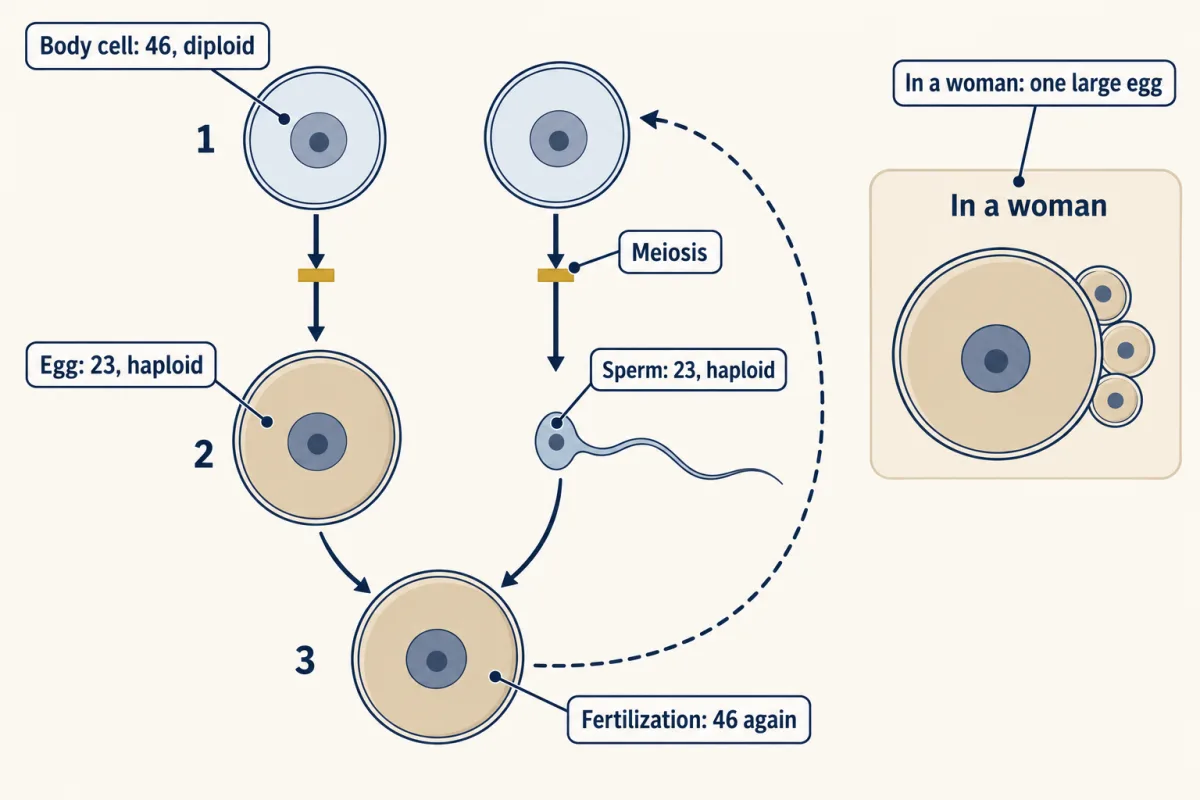
A cell with two sets of chromosomes, one set from each parent, is diploid. A cell with one set is haploid. A gamete is a sex cell, an egg or a sperm, and in humans it is haploid, with 23 chromosomes.
Meiosis is the kind of cell division that makes haploid cells from a diploid cell. In animals those cells become gametes. (In plants, meiosis makes spores, which grow and later make gametes.) Before meiosis starts, the cell copies its DNA once. Each chromosome is then two sister chromatids, identical copies joined together. Then come two divisions:
- Meiosis I. The homologous chromosomes line up in pairs. Then the two chromosomes of each pair are pulled apart into two cells. Each cell now has one chromosome of each pair, still in two copies.
- Meiosis II. The sister chromatids of each chromosome separate. There is no DNA copying in between.
The result is usually four cells, each with one chromosome from every pair. In a woman, the divisions are uneven. One large egg forms, and the other products are small cells called polar bodies.
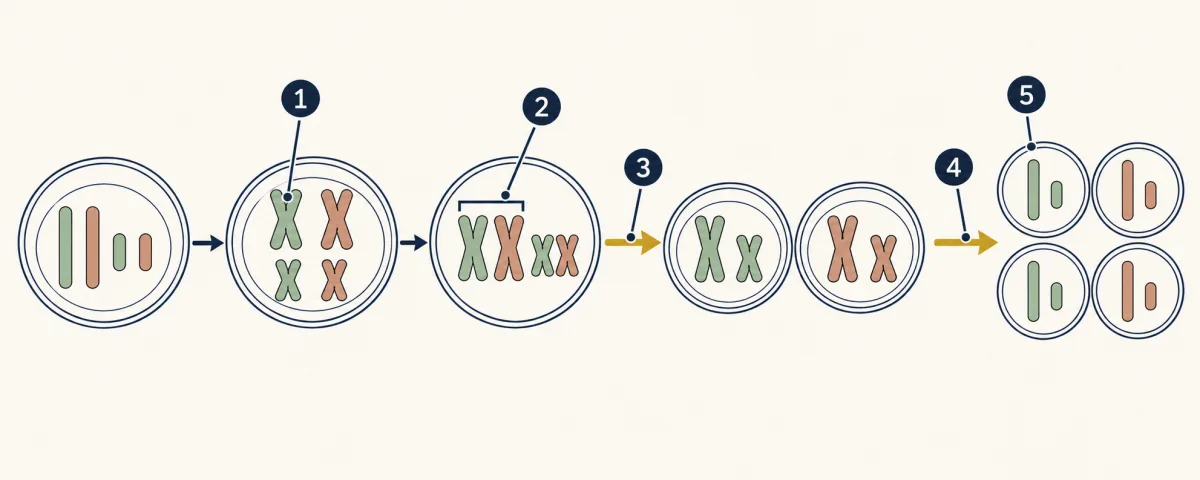
- sister chromatids
- homologous chromosomes
- Meiosis I
- Meiosis II
- haploid
- blank
- blank
- Meiosis I
- Meiosis II
- blank
Word bank: haploid, homologous chromosomes, sister chromatids
- blank
- blank
- blank
- blank
- blank
Check your labels
- sister chromatids
- homologous chromosomes
- Meiosis I
- Meiosis II
- haploid
Fertilization is when an egg and a sperm join. Their two sets of 23 make a diploid cell with 46 again. Because a sex cell gets only one chromosome from each pair, if a parent has two different alleles of a gene, each sex cell has a 50 percent chance of getting either one.
Explain: two ways meiosis mixes alleles
Meiosis I mixes alleles in two ways.
Crossing over is the swapping of matching pieces between the two chromosomes of a pair while they lie side by side in meiosis I. After a swap, one chromosome can carry some alleles from the grandmother and some from the grandfather. Studies that read the DNA of single human sperm count an average of about 22 to 28 crossovers per sperm, depending on the man.
Independent assortment means each chromosome pair lines up and separates on its own, without regard to the other pairs. A deck of cards gives a picture: shuffle well, and each hand you deal is a new mix. The picture breaks because a sex cell always gets exactly one card from each pair, never two from one pair.
Count the choices. Each pair can send either of its two chromosomes, so every pair doubles the number of combinations.
number of chromosome combinations in a sex cell = 2ⁿ, where n is the number of chromosome pairs
For humans, n = 23, so one parent can make 2²³ = 8,388,608, or about 8.4 million, chromosome combinations. Two parents together give 8,388,608 × 8,388,608, which is more than 70 trillion. These are possibilities across many meioses, not children anyone could have, and they ignore crossing over, which adds far more.
One limit: genes that sit close together on the same chromosome tend to travel together. Independent assortment applies to genes on different chromosomes.
Explain: mitosis and meiosis side by side
You met mitosis, the division that makes two cells with the same chromosomes as the parent cell, in The Cell Cycle and Mitosis.
| Mitosis | Meiosis | |
|---|---|---|
| Purpose | Growth, repair, asexual reproduction | Making gametes (in animals) |
| DNA copied | Once | Once |
| Divisions | One | Two |
| Cells made | Usually two | Usually four (one egg in females) |
| Chromosome sets | Diploid stays diploid | Diploid becomes haploid |
| Genetic sameness | Cells match the parent cell | Each cell is a new mix |
The “match” in mitosis is a close match. Rare copying mistakes, called mutations, can change a cell’s DNA. Mutations are the other source of new alleles, and recombination by crossing over and shuffling mixes them into new combinations.
Asexual reproduction, with one parent and mitosis-like division, makes offspring that are genetically the same as the parent. Sexual reproduction makes offspring that differ. Genetic diversity is the variety of alleles and allele combinations in a population. When the environment changes, some combinations may do better than others, so a varied population is more likely to have some members that survive and reproduce. Diversity raises the chances; it does not guarantee survival.
Elaborate: count the combinations
The first four rows are calculations of 2ⁿ from known chromosome numbers. The last four are real measurements of crossovers in human sex cells.
| What is counted | n (pairs) | Value | Units |
|---|---|---|---|
| Pea, chromosome combinations | 7 | 128 | combinations per sex cell (calculated) |
| Fruit fly, chromosome combinations | 4 | 16 | combinations per sex cell (calculated) |
| Human, chromosome combinations | 23 | 8,388,608 | combinations per sex cell (calculated) |
| Dog, chromosome combinations | 39 | 549,755,813,888 | combinations per sex cell (calculated) |
| Human sperm, one donor (Lu, 2012) | 23 | about 26.0 | crossovers per sperm, average |
| Human eggs and embryos (Ottolini, 2015) | 23 | 41.6 (standard deviation 11.3, 51 samples) | maternal crossovers per egg or embryo, average |
| Human sperm, lowest donor average (Bell, 2020) | 23 | 22.2 | crossovers per sperm |
| Human sperm, highest donor average (Bell, 2020) | 23 | 28.1 | crossovers per sperm |
Sources: chromosome numbers from the National Human Genome Research Institute chromosomes fact sheet (updated 2020) and, for pea, Yang and colleagues, Nature Genetics (2022). Crossovers: Lu and colleagues, Science (2012), 99 sperm from one man in his late forties (the 26.0 average is for the sperm with a complete genome); Ottolini and colleagues, Nature Genetics (2015), eggs and early IVF embryos; Bell and colleagues, Nature (2020), 31,228 sperm from 20 donors. The studies used different people and methods, so they are not a controlled egg-versus-sperm comparison.
- A dog has 39 pairs and a human has 23. How many more pairs does the dog have, and about how many times more combinations does that give?
- Compare the egg average with the sperm averages. Which is higher, and by about how much?
- The Bell donor averages range from 22.2 to 28.1. What does that range tell you that the single Lu value cannot?
Claim, evidence, reasoning
Make a claim that answers the essential question, using the combinations and crossover data.
Start with: Siblings differ because blank.
Start with: Shuffling 23 pairs alone gives each parent blank combinations, and a typical sex cell also carries about blank crossovers.
Start with: Each child comes from a different egg and a different sperm, and because blank, those cells almost never carry the same mix.
Compare with a model answer
Siblings differ because each one grows from a different egg and sperm, and meiosis makes each sex cell a new mix. Shuffling the 23 pairs alone gives each parent 8,388,608 combinations. Crossing over adds more: a study of one man counted about 26 crossovers per sperm, and a study of eggs and early embryos found an average of 41.6 maternal crossovers each. So two siblings almost never get the same chromosomes. The limits matter: 2ⁿ is a calculation that treats every chromosome as different, and the crossover numbers come from small samples, including just one sperm donor.
Saved in this browser only.
Design problem
Does sexual reproduction help a population adapt to a harsh environment? Plan a lab investigation with yeast, which can reproduce with or without meiosis. Name your variables, constants, controls, sample size and repeated trials, and say how you will stay safe.
One way to do it
- Question: Do yeast populations that go through meiosis and mating adapt faster to a hot, salty environment than populations that cannot?
- Independent variable: whether the population can reproduce sexually. Use a strain that can and a closely matched strain that cannot.
- Dependent variable: fitness after many generations, measured by growing each evolved population mixed with its ancestor and seeing which one increases.
- Constants: the same growth medium, number of generations, number and timing of starvation rounds that trigger meiosis and spore formation, and transfer schedule.
- Controls: run both kinds of population in a comfortable environment too. If sex helps only in the harsh one, the benefit depends on the environment. Also keep frozen ancestors to compare against.
- Sample size and trials: several separate populations of each kind in each environment, since one population can change by chance.
- Safety: use lab yeast strains, wear goggles, handle heat and sterilizing equipment with your teacher, and follow the lab’s rules for disposing of cultures.
A larger gain for the sexual populations in the harsh environment only would support the idea that mixing alleles helps most when conditions change.
Evaluate: check your thinking
Brothers and sisters differ because each grows from a different egg and a different sperm. Meiosis makes every sex cell a new mix: crossing over swaps pieces of paired chromosomes, and independent assortment shuffles 23 pairs into millions of combinations. Identical twins come from one fertilized egg, which is why they match so closely.
Science practices you used: making predictions and testing them with a model, calculating combinations with a formula, reading a table of measured averages and ranges, planning a fair test with controls and repeated trials, and naming the limits of a model and of small samples.
How we measure it
Single-sperm genome sequencing
The DNA of one sperm cell is copied many times over and then read. Comparing it with the father’s two chromosome sets shows where a stretch from one set switches to the other, which marks a crossover.
Following an egg and its polar bodies
Researchers read many DNA markers in an egg (or early embryo) and in the small polar bodies made beside it during meiosis. Because all the products of one meiosis are read together, they can trace which chromosome went where and where crossing over happened.
Competition test of evolved yeast
A yeast population that has evolved in the lab is grown mixed with its ancestor, and the change in their numbers is measured. The population that increases faster is the fitter one in that environment.
Finish line
Test yourself
8 questions
Practice and MCAT-style, with explained answers.
Next · Lesson 20
Mendel and Punnett Squares
Crossing purple-flowered and white-flowered pea plants gave only purple offspring, yet white flowers came back in the next generation. Where had the white been hiding?
Continue →