Life Science · Unit 3: Energy for life
Partners in Energy
If plants make their own food, why do they use oxygen too, and why does the oxygen in a Bay creek rise and fall every day? You run a day and a night in a virtual tank of Bay water and read a real oxygen record from a Virginia creek. Afterwards you can explain how photosynthesis and cellular respiration depend on each other and use data to back up that idea.
Where this lesson sits
- Virginia SOL LS.4 a
- Virginia SOL LS.4 b
- Practices LS.1 c, LS.1 d, LS.1 e
Essential question: If plants make their own food, why do they need oxygen too, and why does the Bay's oxygen go up and down every day?
-
Life Science (grade 7) LS.4 a, LS.4 b You are here
This lesson
-
Biology
Preview it at high school level
In Biology you will write the two processes as balanced chemical equations, side by side. You will count atoms and see that the same carbon, hydrogen and oxygen atoms move from one equation to the other and back. You will also meet ATP, a small molecule that carries energy from respiration to the jobs a cell does. Then you will use these ideas to explain low-oxygen zones in the Chesapeake Bay. When large amounts of algae die, bacteria break them down, and the respiration of those bacteria can use up the oxygen in deep water.
-
Biology II Biology II: Advanced Survey of Biology Topics, BIOII.3 b; Ecology, EC.3 a
Preview where it goes next
In Biology II: Advanced Survey of Biology Topics (BIOII.3 b), photosynthesis splits into two linked stages: light-dependent reactions that capture energy in ATP and NADPH, and the Calvin cycle that uses them to build sugar from carbon dioxide. The same course traces respiration through its stages and shows how the two processes cycle matter. The Ecology course (EC.3 a) follows the energy instead: how much of the sunlight producers capture becomes new living material, and how much passes to consumers and decomposers.
-
College
Watch first Two Processes That Need Each Other · 2:39
Taskinas Creek is a small marsh creek off the York River in Virginia. A sensor there checks the oxygen in the water every 15 minutes. On one dry summer day, the water held far more oxygen at 6 p.m. than in the early morning. Marsh grasses grow along this creek, and animals live in its water. Something adds oxygen to the water. Something takes it away. Before you find out what, decide what you think now.
What do you think? Decide before you read.
-
Scientists disagree: Plants and fungi respire too. Plant cells contain mitochondria as well as chloroplasts. If you seal a plant in a dark jar, a sensor shows carbon dioxide going up, because the plant’s cells keep breaking down sugar.
What scientists think
Scientists disagree: Plants and fungi respire too. Plant cells contain mitochondria as well as chloroplasts. If you seal a plant in a dark jar, a sensor shows carbon dioxide going up, because the plant’s cells keep breaking down sugar.
-
Scientists disagree: Plants make oxygen in the light, but they also use oxygen for respiration all the time. In experiments on Arabidopsis seedlings and moss, blocking the mitochondria showed the cells depend on them, both in the dark and while photosynthesis is running.
What scientists think
Scientists disagree: Plants make oxygen in the light, but they also use oxygen for respiration all the time. In experiments on Arabidopsis seedlings and moss, blocking the mitochondria showed the cells depend on them, both in the dark and while photosynthesis is running.
-
Scientists disagree: They do happen in different organelles. But compare what goes in and what comes out of each one. The outputs of one process are the inputs of the other, so the two are linked.
What scientists think
Scientists disagree: They do happen in different organelles. But compare what goes in and what comes out of each one. The outputs of one process are the inputs of the other, so the two are linked.
Explore: run a day and a night in a tank of Bay water
In this virtual tank you have Bay water, underwater grass, algae and fish. A clock runs through 24 hours. Bars show the oxygen and carbon dioxide in the water. A line graph plots the oxygen hour by hour. You can change the amount of plants and algae, the number of animals, and the sky (sunny or cloudy).
- Highest oxygen
- –
- Lowest oxygen
- –
- Oxygen at the next dawn
- –
Press Run 24 hours to start a day in the tank. Predict the oxygen line first.
In this sketch: amounts are relative units, not mg/L. There is no gas exchange with the air, the temperature stays the same, daylight lasts from 6 a.m. to 6 p.m., and plants and animals are drawn as blocks. A cloudy sky lets through 60 out of 100 parts of the light, a plant block adds up to 3 units an hour and uses 0.4, an animal block uses 0.8, and a gas below 15 units slows its process (all made-up numbers for this sketch). Carbon dioxide is drawn as 100 minus oxygen (a sketch simplification). “Very low” here means under 20 units.
Rule to keep: photosynthesis adds oxygen only in light, but respiration uses oxygen day and night. A real creek is bumpier, because tides, air and warm water also change oxygen.
Try this.
- Predict what the oxygen line will do between sunset and sunrise. Then run one day and check.
- Predict how a cloudy day will change the oxygen at noon. Then switch the sky and test it.
- Add many fish and remove most of the grass. Predict the oxygen at dawn before you run it.
Explain: two processes in one leaf cell
- photosynthesis
- cellular respiration
- chloroplast
- mitochondria
- reactant
- product
- interdependent
- dissolved oxygen
You met both processes in Photosynthesis Feeds the World and Releasing Energy from Food. Now put them in the same cell.
Photosynthesis uses radiant energy to make sugar (glucose) and oxygen from carbon dioxide and water. It happens in the chloroplast, a green part of the cell that takes in light.
carbon dioxide + water + radiant energy → sugar (glucose) + oxygen
Cellular respiration joins sugar with oxygen and releases energy the cell can use. Most of it happens in the mitochondria, small parts found in almost all plant and animal cells.
sugar (glucose) + oxygen → carbon dioxide + water + energy for the cell
A green leaf cell has both organelles. An animal cell has mitochondria but no chloroplasts. Not every plant cell is green, though. Root cells usually have no chloroplasts. They get sugar sent down from the leaves.
| Photosynthesis | Cellular respiration | |
|---|---|---|
| Where | Chloroplast | Mostly in mitochondria |
| Goes in | Carbon dioxide, water, radiant energy | Sugar (glucose), oxygen |
| Comes out | Sugar (glucose), oxygen | Carbon dioxide, water, usable energy |
| When | Only in light | Day and night |
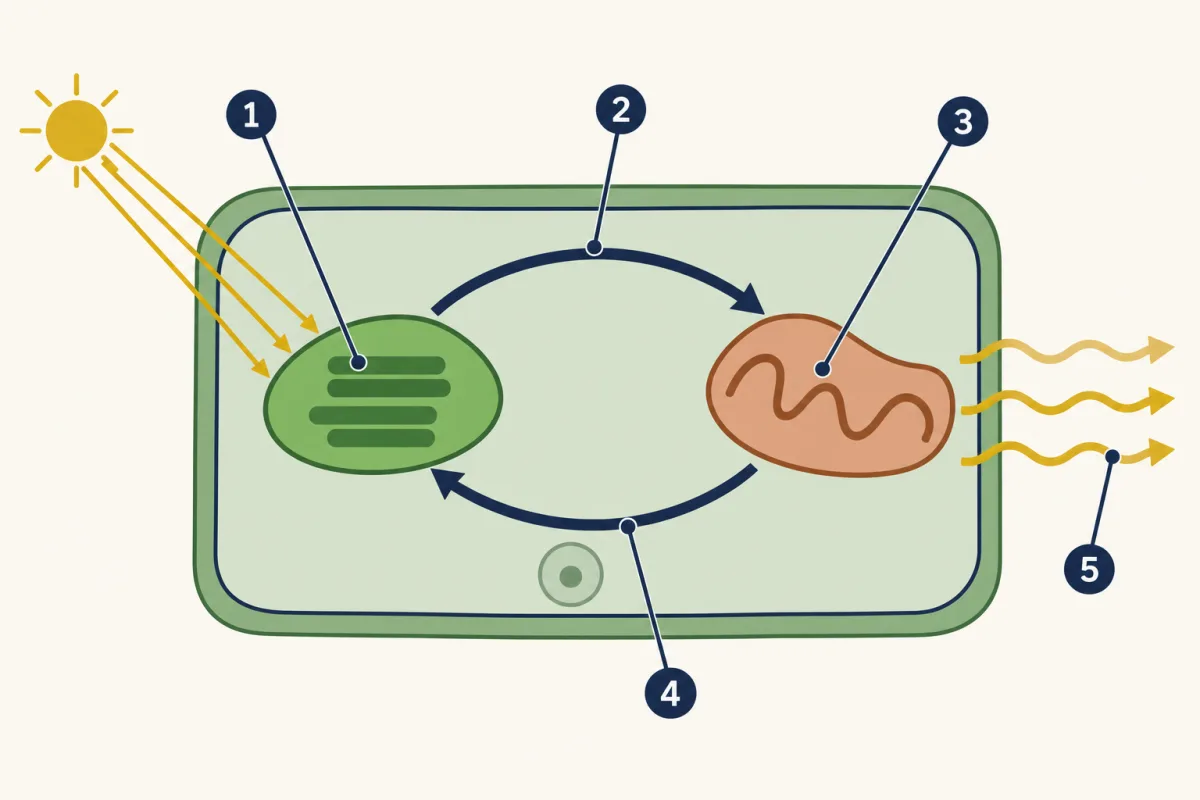
- chloroplast
- sugar and oxygen
- mitochondrion
- carbon dioxide and water
- heat
- chloroplast
- blank
- mitochondrion
- blank
- blank
Word bank: carbon dioxide and water, heat, sugar and oxygen
- blank
- blank
- blank
- blank
- blank
Check your labels
- chloroplast
- sugar and oxygen
- mitochondrion
- carbon dioxide and water
- heat
Explain: what one makes, the other uses
A reactant is a substance that goes into a chemical process. A product is a substance that comes out. Look at the two word equations again. The products of photosynthesis, sugar and oxygen, are the reactants of respiration. The products of respiration, carbon dioxide and water, are the reactants of photosynthesis. Processes that depend on each other like this are interdependent. Each one needs the other.
Matter and energy move differently through this pair:
- Matter is used again. The same carbon, oxygen and hydrogen go around and around.
- Energy flows one way. Light from the sun becomes chemical energy in sugar. Respiration releases that energy for life processes. Some of it leaves as heat. Energy is never made or used up. It changes form.
Producers, like the Bay’s algae and underwater grasses, make the food and oxygen that almost every food web needs.
Each process also has things that change its speed:
- Photosynthesis: light, carbon dioxide and temperature.
- Respiration: temperature, oxygen and sugar (glucose).
Explain: why creek oxygen rises and falls
Dissolved oxygen is oxygen gas mixed into water. Fish, crabs, plants and microbes can use it there. Scientists measure it in milligrams per liter (mg/L).
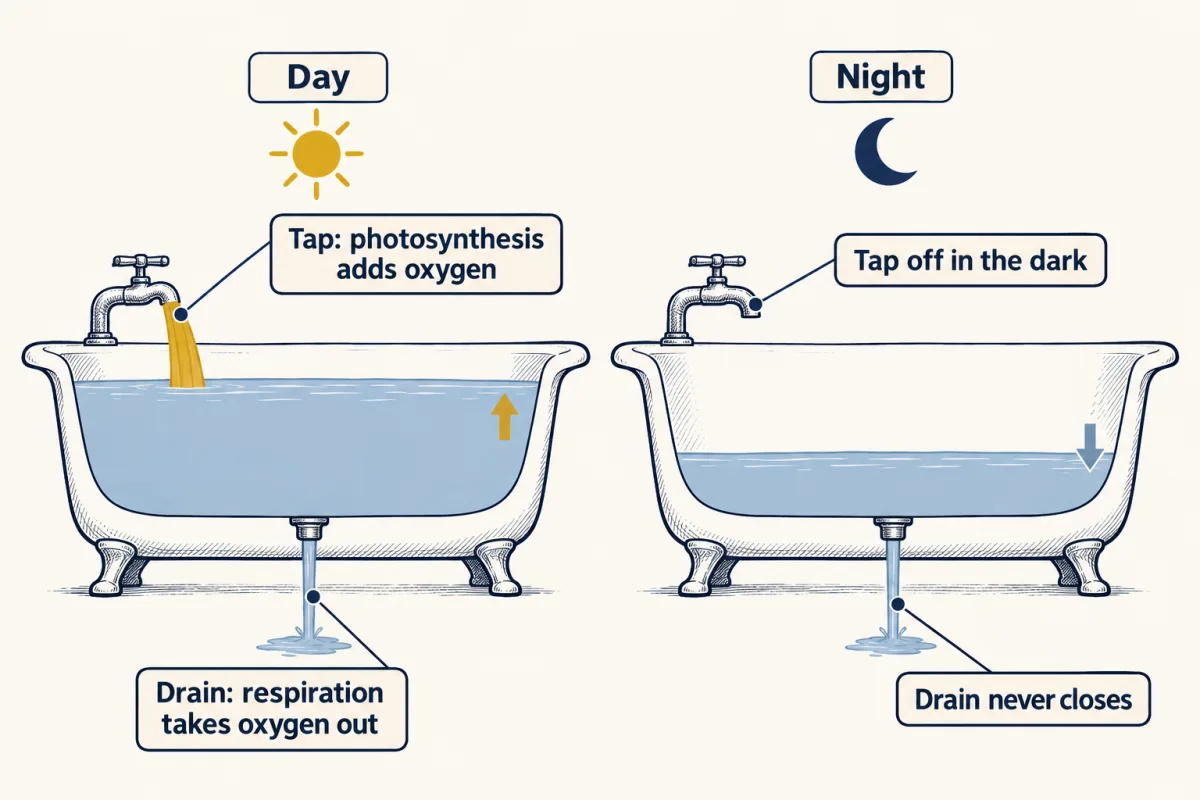
In daylight, algae and grasses photosynthesize and add oxygen to the water. At the same time, nearly every living thing in the creek respires and takes oxygen out. On a bright day, photosynthesis often adds oxygen faster than respiration takes it. The level climbs. After dark, photosynthesis stops, but respiration does not. The level falls through the night.
Think of a bathtub with the tap running and the drain open. Sunlight turns the tap on. The drain never closes. The comparison breaks because a real creek is open. Tides bring in new water. Air at the surface can add oxygen, or take some away when the water holds extra. Warm water holds less oxygen than cold water.
When oxygen drops very low over a large area, many animals can die. You will study these dead zones in Big Changes (a later lesson).
- In daylight, oxygen goes up because blank adds oxygen faster than blank uses it.
- At night, oxygen goes down because blank stops, but blank keeps going.
Elaborate: a real day in Taskinas Creek
Here are real readings from Taskinas Creek. It is a shallow creek, and the tide moves water in and out from the York River. The light readings come from a weather station about 200 meters away. Times are standard time, one hour behind summer clock time.
| Time | Dissolved oxygen (mg/L) | Water temperature (°C) | Light in the 15 minutes before (mmol photons per m²; higher means more light) |
|---|---|---|---|
| July 30, midnight | 5.7 | 32.6 | 0.0 |
| 3 a.m. | 4.2 | 30.6 | 0.0 |
| 6 a.m. | 4.0 | 29.3 | 90.8 |
| 9 a.m. | 5.3 | 29.1 | 1,170.8 |
| Noon | 5.7 | 30.3 | 1,155.6 |
| 3 p.m. | 4.6 | 31.3 | 1,396.5 |
| 6 p.m. | 10.7 | 32.6 | 240.6 |
| 9 p.m. | 9.0 | 31.2 | 0.0 |
| July 31, midnight | 6.4 | 30.3 | 0.0 |
Source: Chesapeake Bay National Estuarine Research Reserve in Virginia (run by VIMS), NOAA monitoring program, stations cbvtcwq (water) and cbvtcmet (weather), July 30, 2023. No rain fell that day. The table shows one reading every 3 hours. In the full record, the lowest oxygen was 3.4 mg/L at 2:45 a.m., and the highest was 10.8 mg/L at 5:45 p.m. The last midnight reading carries a rain-event note in the record.
- How much did oxygen fall between 6 p.m. and midnight? What was the light during most of that time?
- Find the lowest and highest oxygen in the table. Was it light or dark at each of those times?
- Oxygen dropped between noon and 3 p.m., even in bright light. Name one thing besides living things that could explain that.
Claim, evidence, reasoning
Make a claim that answers the essential question: why does the oxygen in this creek go up and down over a day? Use the Taskinas Creek data.
Start with: The oxygen in the creek rises and falls because blank.
Start with: At 6 p.m. oxygen was blank mg/L, and by midnight, with light at blank, it was blank mg/L.
Start with: Photosynthesis adds oxygen only when there is blank, but respiration uses oxygen blank, so blank.
Compare with a model answer
The creek’s oxygen rises and falls partly because photosynthesis adds oxygen only in light, while respiration uses it all day and night. Oxygen was 10.7 mg/L at 6 p.m. By midnight, with zero light, it had fallen to 6.4 mg/L, a drop of 4.3 mg/L. The early-morning readings, 4.0 to 4.2 mg/L, were among the lowest. One limit: this is one day at one creek. Tides and warm water can also change oxygen, which may explain the dip at 3 p.m.
Saved in this browser only.
Design problem
Plan an experiment to test whether a water plant uses oxygen in the dark and adds it in the light. You can buy water plants and a dissolved oxygen probe for school use.
One way to do it
- Question: Does light change whether a water plant adds or removes dissolved oxygen?
- Independent variable: light or dark (a lamp or a closed cabinet).
- Dependent variable: change in dissolved oxygen over 4 hours, in mg/L.
- Constants: same jar size, 500 mL of the same water, about 2 grams of plant per jar, same room temperature.
- Control: jars with water and no plant, in light and in dark. They show how much oxygen changes without the plant.
- Trials: three jars of each kind. Report the mean change.
- Safety: keep lamps and cords away from water, wash your hands after, and never release store-bought plants into a creek or pond.
If oxygen rises in the lit jars and falls in the dark jars, while the plain water barely changes, the plant added oxygen in light and used it in darkness.
Evaluate: check your thinking
In Taskinas Creek, algae and other producers in the water probably added oxygen by photosynthesis while the sun was up. Nearly every living thing in the creek, plants included, used oxygen for respiration day and night. When light faded, only the using went on. Oxygen fell until the early hours of the morning. Tides and temperature moved the curve too. That is why the real record is bumpier than the tank.
Science practices you used: making and testing predictions with a model, reading a real data table, finding a pattern and other possible causes, and making a claim backed by evidence and reasoning.
How we measure it
Continuous water-quality sensor (sonde)
A sensor package stays in the water and measures dissolved oxygen, temperature and other properties every 15 minutes. Scientists line up the readings by time to see daily patterns.
Light sensor (PAR sensor)
A sensor on a weather station counts the light that plants can use for photosynthesis. Its readings show when the sun was up and how bright it was, to compare with the oxygen record.
Finish line
Test yourself
8 questions
Practice and MCAT-style, with explained answers.
Next · Lesson 12
Food Webs and Energy
If ospreys eat menhaden and menhaden eat plankton, how much of the sun’s energy ever reaches an osprey?
Continue →