Biology · Unit 3: Bacteria and viruses
How Microbes Multiply
How do bacteria and viruses make more of themselves, and why can a cold sore come back after it heals? You run a doubling model and a virus life cycle, then read a real growth curve of E. coli. Afterwards you can compare binary fission with the lytic and lysogenic cycles and calculate how a population grows, and why the growth stops.
Where this lesson sits
- Virginia SOL BIO.4b
- Practices BIO.1c, BIO.1d, BIO.1e, BIO.1f
Essential question: How do bacteria and viruses make more of themselves, and why do some infections come back years later?
-
Life Science (grade 7) LS.10 b
Review it at grade 7 level
In Life Science you learned that some living things reproduce asexually. One parent makes offspring, and the offspring are genetically identical to the parent. Other living things reproduce sexually, with two parents, and the offspring are different from each parent. You may have seen a picture of one cell becoming two. Biology adds the names and steps: bacteria split by binary fission or grow buds, can trade DNA by conjugation, and viruses copy themselves only inside a host cell, by the lytic or lysogenic cycle.
-
Biology BIO.4b You are here
This lesson
-
Biology II Biology II: Advanced Survey of Biology Topics, BIOII.2 d; Genetics, GEN.4 d
Preview where it goes next
Virginia’s Advanced Survey of Biology course compares ways of reproducing asexually across life: binary fission in prokaryotes, budding, fragmentation, vegetative propagation in plants and spores. The Genetics course asks how bacteria vary if their offspring are clones. It names three ways bacteria gain genes from outside: conjugation (DNA passed from cell to cell), transformation (DNA taken up from the surroundings) and transduction (DNA carried by a virus). It also explains that bacteria usually have one circular chromosome and may carry plasmids, small extra circles of DNA that often move during conjugation. Mutation adds variation too, even in a clone.
-
College
Watch first Copies Made By Cells · 2:54
Under the best laboratory conditions, one E. coli cell can split into two about every 20 minutes. A cold sore can heal, then come back later in about the same spot. Both are stories about making copies. A bacterium copies itself. A virus cannot copy itself at all, yet the herpes virus that causes cold sores can stay in your body for years. How do bacteria and viruses multiply, and what stops them?
What do you think? Decide before you read.
-
Scientists disagree: There is no mother, father or egg. Under a microscope, a bacterium grows longer, copies its DNA and pinches into two cells. Textbooks call this binary fission. A few kinds of bacteria grow a bud instead, which researchers have filmed with time-lapse microscopes.
What scientists think
Scientists disagree: There is no mother, father or egg. Under a microscope, a bacterium grows longer, copies its DNA and pinches into two cells. Textbooks call this binary fission. A few kinds of bacteria grow a bud instead, which researchers have filmed with time-lapse microscopes.
-
Scientists disagree: A virus cannot make copies of itself without a host cell. Inside an infected cell, the cell’s own machinery builds viral parts, and new viruses are put together from those parts. Scientists see this by breaking open infected cells at different times: early on, there are parts but no whole viruses.
What scientists think
Scientists disagree: A virus cannot make copies of itself without a host cell. Inside an infected cell, the cell’s own machinery builds viral parts, and new viruses are put together from those parts. Scientists see this by breaking open infected cells at different times: early on, there are parts but no whole viruses.
-
Scientists disagree: In a closed flask, scientists measure the culture growing cloudier and then holding steady. Food runs out and wastes build up. The 20-minute doubling time is a best-case number for one kind of bacterium in a lab, not a rule that lasts.
What scientists think
Scientists disagree: In a closed flask, scientists measure the culture growing cloudier and then holding steady. Food runs out and wastes build up. The 20-minute doubling time is a best-case number for one kind of bacterium in a lab, not a rule that lasts.
Explore: grow a population and follow a virus
The simulation has two panels. In the first, you start a bacterial population, pick a doubling time and set how much food is in the dish, then watch the count over time. In the second, you step a phage, a virus that infects bacteria, through an infection and choose the lytic or the lysogenic path.
Panel 1. Double a bacterial population
- Doublings finished
- 6
- Cells with endless food
- 64
- Cells with the food ceiling
- 64
In this sketch: one starting cell, no waiting before growth starts, no cells dying, and growth runs at full speed until it stops at a ceiling set by food alone (a real culture slows first, and wastes build up). The ceiling (4,096 cells at full food) and doubling times other than 20 minutes are made-up sketch values, not measurements.
Panel 2. Follow a phage
- Cells carrying the prophage
- –
- Host divisions
- –
- Cells that burst
- –
In this sketch: you pick the path, the only cell that dies is one that bursts, and the picture shows at most 8 cells.
In this sketch, a population doubles once each doubling time until food runs low and wastes build up, and a prophage is copied into both daughter cells each time its host divides.
Try this.
- Predict how many cells one cell becomes after 2 hours with a 20-minute doubling time. Then run it.
- Keep the doubling time the same and halve the food. Predict what changes about the curve, then test.
- In the virus panel, choose the lysogenic path and let the host divide three times. Predict how many cells carry the viral DNA.
- Switch a lysogenic cell to the lytic path. Predict what happens to that cell.
Explain: how bacteria make more bacteria
- asexual reproduction
- binary fission
- budding
- conjugation
- plasmid
- bacteriophage
- host cell
- lytic cycle
- lysogenic cycle
- prophage
- doubling time
Asexual reproduction is reproduction with one parent, where the offspring get copies of that parent’s DNA. Most bacteria reproduce this way.
The most common method is binary fission, when one bacterial cell grows, copies its DNA and splits into two cells. Each new cell gets a complete copy of the chromosome. The result looks like mitosis, which you met in the cell cycle lesson: one cell becomes two matching cells. The process is simpler, though, because a bacterium has no nucleus.
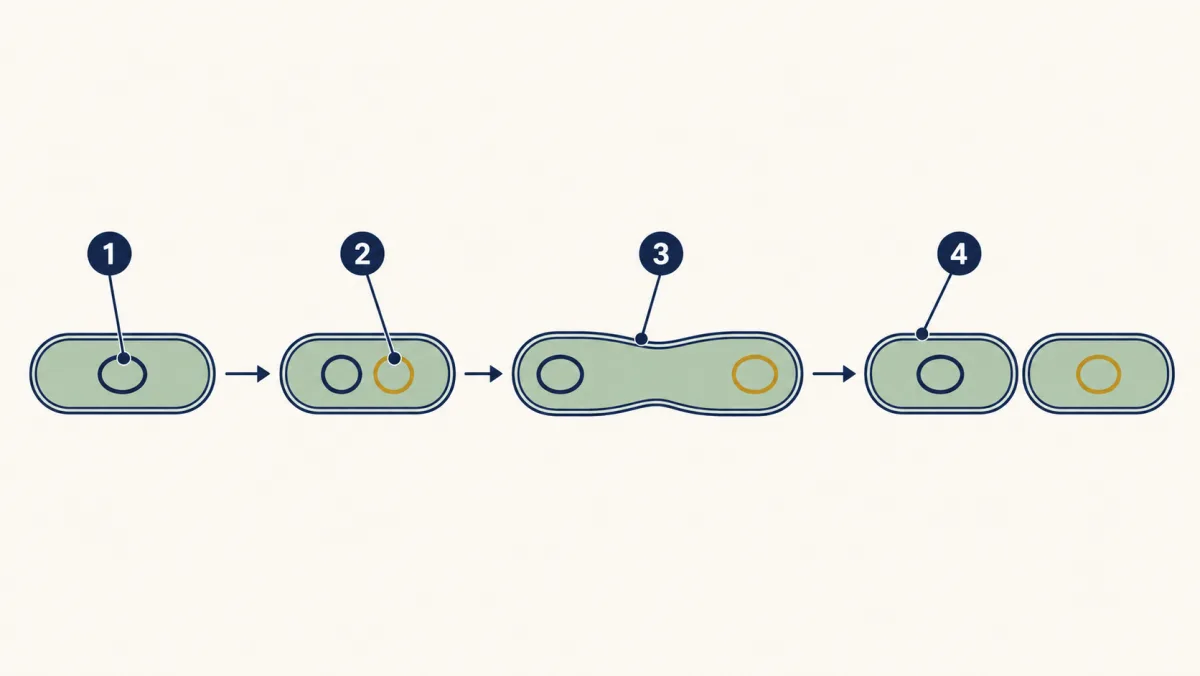
- chromosome
- copy of the chromosome
- grows longer
- daughter cells
- chromosome
- blank
- blank
- daughter cells
Word bank: copy of the chromosome, grows longer
- blank
- blank
- blank
- blank
Check your labels
- chromosome
- copy of the chromosome
- grows longer
- daughter cells
Some bacteria use budding, when a small new cell grows out of the parent and then breaks off. In the ocean bacterium Hyphomonas neptunium, buds form at the tip of a thin stalk. When the bud breaks off, it swims away as a new cell.
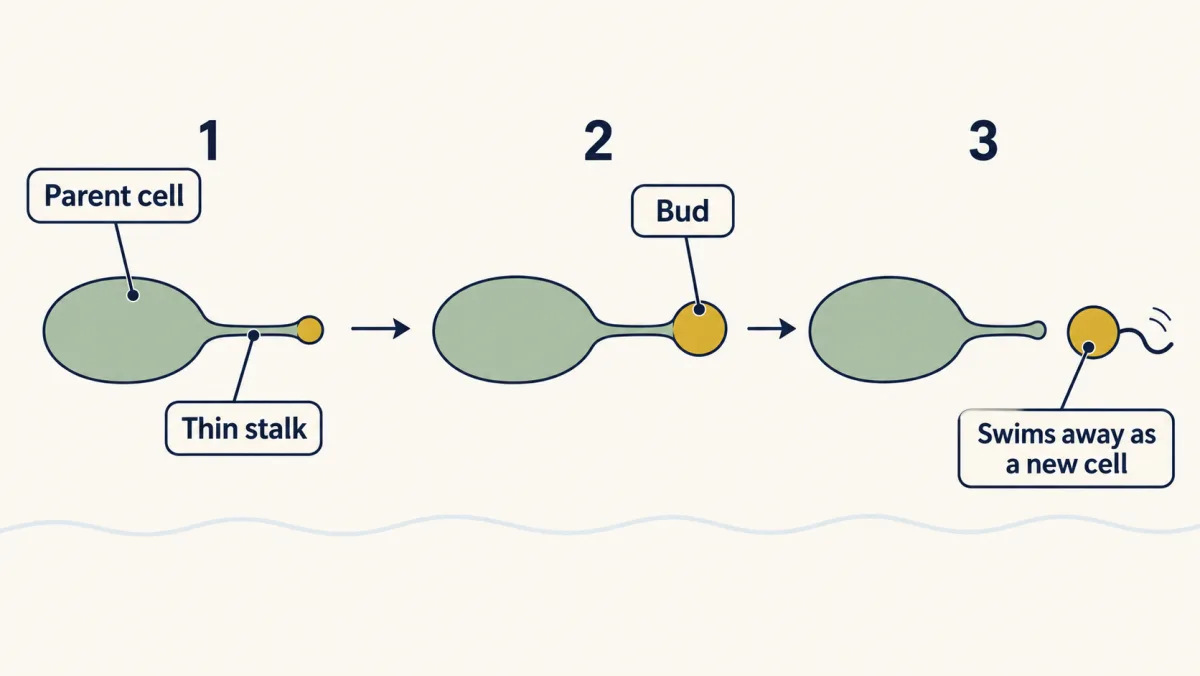
The daughter cells are usually genetically identical. “Usually” matters. Copying DNA sometimes makes mistakes, and sequencing studies of lab E. coli found mutations building up over many generations.
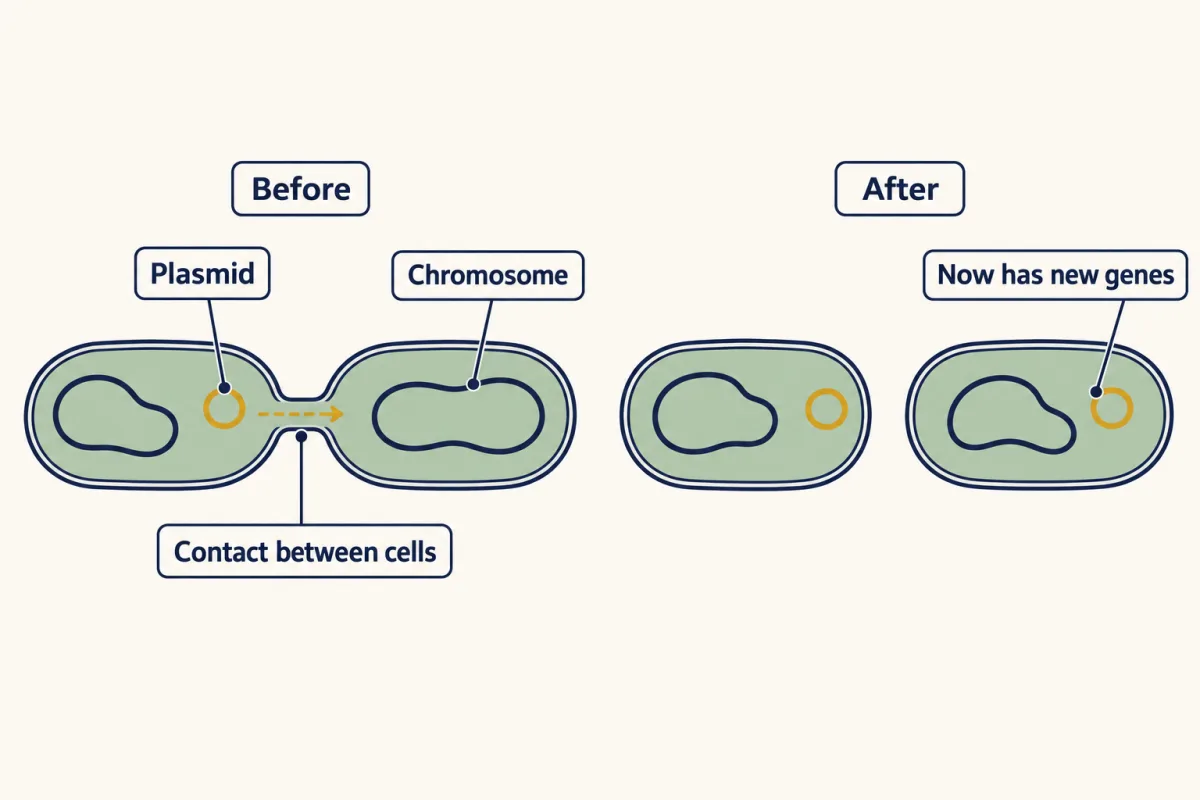
Bacteria have one more way to change their genes. Conjugation is when one bacterial cell passes DNA directly to another through contact. The DNA is often a plasmid, a small extra circle of DNA separate from the chromosome. Conjugation does not make a new cell. Afterward there are still two cells, but one has new genes. The Virginia SOL calls conjugation a form of sexual reproduction, because genes from two cells are combined. Many biologists call it gene transfer, because no new cell is made. Conjugation is far rarer than binary fission.
Explain: how viruses make more viruses
A virus cannot split, grow or make anything on its own. It needs a host cell, the living cell a virus infects and uses to make new viruses. The living-or-not lesson explains why. A bacteriophage, or phage, is a virus that infects bacteria.
The lytic cycle is the path where a virus takes over the host, the host builds new viruses, and the cell bursts open to release them. It runs like this:
- The phage attaches to the bacterium and injects its DNA.
- The host’s machinery copies the viral DNA and builds viral parts.
- New phages are assembled from those parts.
- The cell bursts and the new phages escape. The host cell dies.
The lysogenic cycle is the path where the viral DNA joins the host’s own DNA and is copied along with it. The best-known example is phage lambda, which infects E. coli. Its DNA becomes part of the bacterial chromosome. That stored viral DNA is called a prophage. Each time the bacterium divides by binary fission, both daughter cells get a copy. The cell stays alive, and the virus spreads quietly through a growing family of cells. Later, something such as damage to the cell’s DNA can switch the prophage into the lytic cycle.
| Binary fission (bacteria) | Lytic cycle (virus) | Lysogenic cycle (virus) | |
|---|---|---|---|
| Who does the copying | The bacterium itself | The host cell | The host cell, each time it divides |
| What is made | Two new cells | Many new virus particles | Host cells that carry viral DNA |
| Host cell afterward | No host involved | Usually dies | Alive, until a switch to lytic |
Now the cold sore. Herpes simplex virus infects people, not bacteria, but it uses a similar hiding strategy. It can stay in sensory nerve cells, the cells that carry feeling from the skin. Studies of infected human and mouse tissue suggest its DNA stays as a separate circle in the nucleus rather than joining the chromosome the way lambda does. From time to time the virus can become active again and travel back to the skin, and a new sore appears.
Explain: doubling, and why it stops
Doubling time is the time it takes a population to double in number. If the doubling time stays the same, you can predict the count:
number of cells = starting number × 2 × 2 × 2 … (one × 2 for each doubling)
Here is a worked example. A model population starts with 100 cells and doubles every 20 minutes. How many cells after 2 hours?
- 2 hours is 120 minutes.
- 120 minutes ÷ 20 minutes = 6 doublings.
- 100 → 200 → 400 → 800 → 1,600 → 3,200 → 6,400 cells.
Starting from one E. coli cell with 21 doublings (7 hours), the model gives 2,097,152 cells. That is the “millions in an afternoon” from the opening. These are calculated numbers, not counts. The model assumes no cells die, no waiting before growth starts and endless food.
Real cultures follow a curve with stages. First there is a lag, where cells are active but the count barely rises. Then comes fast growth, close to steady doubling. Last, food runs low and wastes build up, so growth levels off. The same limits apply to every population, as the carrying capacity lesson shows.
Elaborate: a real growth curve
Scientists often track a liquid culture by its cloudiness, called optical density at 600 nanometers (OD600). More cells scatter more light, so the number goes up. It is not a count of cells.
| Time (hours) | OD600 cloudiness (no units) |
|---|---|
| 0.5 | 0.078 |
| 2 | 0.079 |
| 4 | 0.080 |
| 6 | 0.084 |
| 8 | 0.134 |
| 10 | 0.198 |
| 12 | 0.313 |
| 14 | 0.322 |
| 16 | 0.318 |
| 18 | 0.315 |
These are raw readings from one well, curve 15, of E. coli strain BW25113 grown in a defined lab medium, from the dataset of Honoka Aida and Bei-Wen Ying (deposited on figshare in 2025). The readings were taken every 30 minutes; this table shows ten of them. The raw numbers include some cloudiness from the medium itself.
- Between which times does the reading barely change? Between which times does it rise fastest?
- How much did the reading rise from 6 to 12 hours? How much did it change from 14 to 18 hours?
- The 20-minute doubling time is for E. coli in the best conditions. Does this curve show that? What would you need to know?
Claim, evidence, reasoning
Make a claim that answers this question: can a bacterial population keep doubling forever? Use the growth table.
Start with: The data show that the population blank.
Start with: From 6 to 12 hours the reading rose from blank to blank, but from 14 to 18 hours it blank.
Start with: This happens because blank, so doubling stops when blank.
Compare with a model answer
A bacterial population cannot keep doubling forever. In this E. coli culture the cloudiness barely moved for the first 6 hours, from 0.078 to 0.084. It then rose steeply to 0.313 by 12 hours. From 14 to 18 hours it stayed near 0.32 and even dipped a little. The cells multiplied faster once they got going, but in a closed well the food runs low and wastes build up, so growth levels off. One limit: this is one well of one strain in one medium, and cloudiness is not a cell count.
Saved in this browser only.
Design problem
Baker’s yeast is a single-celled fungus, not a bacterium, but it also reproduces by budding and is safe for a classroom. Plan an investigation to test whether the amount of sugar changes how high a yeast population grows before it levels off.
One way to do it
- Independent variable: sugar in warm water, for example 0, 1, 2 and 4 grams per 100 mL.
- Dependent variable: cloudiness every hour, using a turbidity probe or by comparing against a printed card behind the tube, for about 8 hours.
- Constants: the same yeast packet and amount, the same water volume and temperature, the same tubes.
- Control: the tube with no sugar.
- Trials and sample size: three tubes per sugar level, then average them.
- Safety: use only yeast from the store, as your teacher directs. Never grow microbes from skin, soil or surfaces, because you cannot know what will grow.
If the high-sugar tubes level off higher, food limits the population. If all tubes level off at the same height, something else, such as wastes, may set the limit first.
Evaluate: check your thinking
One E. coli cell can become millions in hours under the best conditions, but doubling cannot go on forever; a real culture levels off. A cold sore comes back because herpes virus can stay in nerve cells and become active again, a hiding strategy like, but not the same as, a lysogenic phage.
Science practices you used: predicting and testing with a model, calculating with doublings, reading a growth table, naming the limits of one data set and planning a fair test with a control and repeated trials.
How we measure it
Optical density (cloudiness) readings
A machine shines light of one color (600 nanometers) through a liquid culture and measures how much gets scattered by cells. Readings taken every 30 minutes trace a growth curve, but turning cloudiness into a number of cells needs a separate calibration.
Viable plate count
A diluted sample is spread on a dish of food gel, and each cell that can grow there makes a visible colony. Counting colonies estimates live cells, reported as colony-forming units.
Time-lapse fluorescence microscopy
A glowing tag marks one part of the chromosome, and a microscope takes pictures over hours. In a budding bacterium this showed when the copied chromosome moved into the bud.
Finish line
Test yourself
8 questions
Practice and MCAT-style, with explained answers.
Next · Lesson 14
Microbes in Bodies and Ecosystems
Why do the roots of a healthy soybean plant carry small bumps full of bacteria, and what would the plant lose without them?
Continue →