Biology · Unit 4: DNA and inheritance
Engineering Genes
How can a bacterium make a human hormone, and how should people decide which changes to living things are worth making? You will cut, join and copy DNA in a gene-to-product builder, follow insulin from a human gene to a medicine, and read USDA survey data on engineered crops. Afterwards you can say what each tool of genetic engineering does and weigh a claim about it using benefits, risks, ethics and reliable sources.
Where this lesson sits
- Virginia SOL BIO.5e
- Practices BIO.1a, BIO.1c, BIO.1d, BIO.1f
Essential question: Can we design life, and how should we decide when we should?
-
Life Science (grade 7)
Review it at grade 7 level
In Life Science you learned that DNA is shaped like a twisted ladder, a double helix. The rungs are pairs of the bases A, T, C and G. Chromosomes are strands of tightly wound DNA, and genes on them carry the instructions for traits that pass from parents to offspring. Grade 7 did not cover changing DNA on purpose; genetic engineering is new in Biology. Biology adds the tools that cut, join, copy and sort DNA, and asks how people should decide when to use them.
-
Biology BIO.5e You are here
This lesson
-
Biology II Biology II: Genetics, GEN.7 a-c; Advanced Topics, BIOII.7 d
Preview where it goes next
The Genetics course (GEN.7) returns to recombinant DNA and CRISPR in more detail, and adds gene therapy, crop and livestock modification, conservation genetics, synthetic biology, ethics, and judging popular media for bias. Advanced Topics (BIOII.7 d) adds epigenetics and genetic testing. This lesson stopped at the cut. In those courses you ask what happens next: a cell repairs a CRISPR cut, sometimes making small errors that break a gene and sometimes copying a supplied template. Casgevy, for example, uses the cut to switch back on a form of hemoglobin that is normally made before birth. Newer editors, such as prime editors reported in 2019, can change DNA without cutting both strands.
-
College
Watch first Cut, Join, Copy a Gene · 2:54
From the 1920s on, people with diabetes who needed insulin usually injected insulin taken from the pancreases of cattle and pigs. In 1982 the FDA approved human insulin made by bacteria.
Bacteria do not have a human insulin gene. Today, human insulin products are made by bacteria or yeast that carry DNA for it. How do you get a human gene into a microbe, and how should people decide which changes to living things are worth making?
What do you think? Decide before you read.
-
Scientists disagree: Scientists and health agencies judge each product on its own evidence. The World Health Organization asks for case-by-case safety checks. Moving genes between species also happens in nature: researchers found bacterial DNA that entered sweet potatoes naturally, with no lab involved. Whether people should make a given change is a separate question of values.
What scientists think
Scientists disagree: Scientists and health agencies judge each product on its own evidence. The World Health Organization asks for case-by-case safety checks. Moving genes between species also happens in nature: researchers found bacterial DNA that entered sweet potatoes naturally, with no lab involved. Whether people should make a given change is a separate question of values.
-
Scientists disagree: Every food made from plant or animal cells contains DNA, so it contains genes. Scientists can extract DNA from a strawberry or a banana in a classroom. Engineering adds or changes a gene in an organism that already has thousands of them.
What scientists think
Scientists disagree: Every food made from plant or animal cells contains DNA, so it contains genes. Scientists can extract DNA from a strawberry or a banana in a classroom. Engineering adds or changes a gene in an organism that already has thousands of them.
-
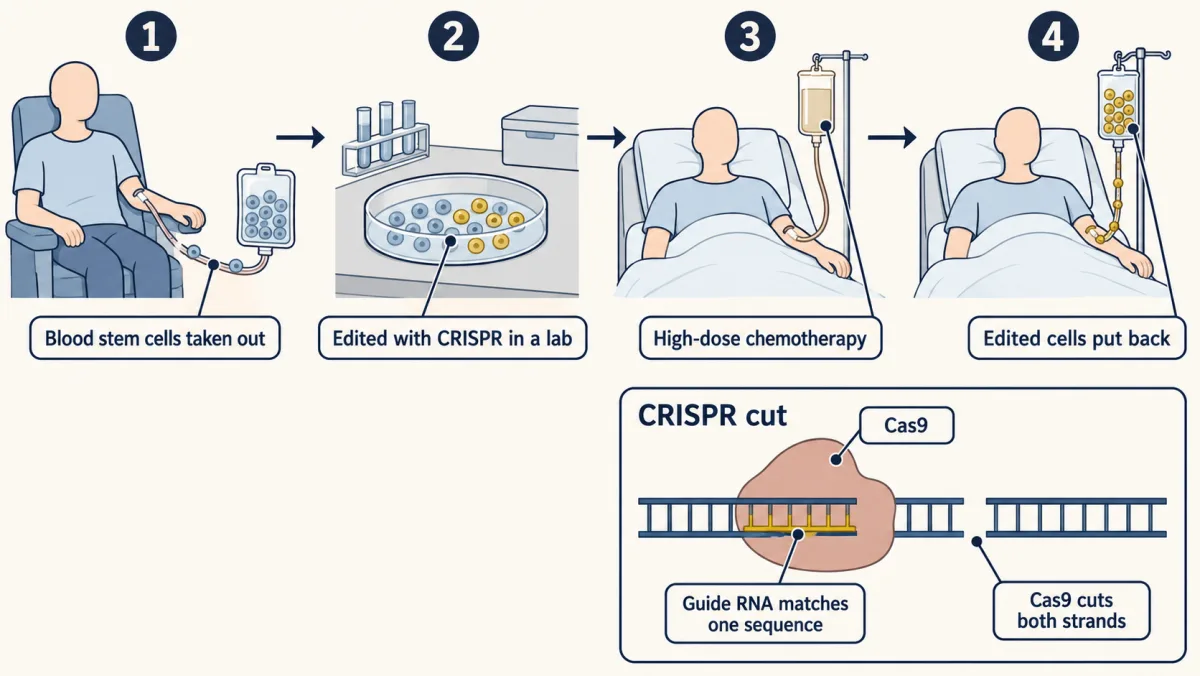
Scientists disagree: The first approved CRISPR treatment edits one kind of cell, a patient’s own blood stem cells, in a lab. The cells go back into the body after chemotherapy, and doctors follow the results for months. Editing can also miss its target or change only some of the cells.
What scientists think
Scientists disagree: The first approved CRISPR treatment edits one kind of cell, a patient’s own blood stem cells, in a lab. The cells go back into the body after chemotherapy, and doctors follow the results for months. Editing can also miss its target or change only some of the cells.
Explore: build a bacterium that makes a product
In the gene-to-product builder, you pick a restriction enzyme to cut open a plasmid and to cut out a gene. You join the pieces with ligase, put the plasmids into bacteria, and then select the bacteria that took one up. A gel panel lets you check the sizes of your DNA pieces against a ladder of known sizes.
- Plasmids carrying the gene (of 40)
- Bacteria that took up a plasmid (of 100)
- Bacteria carrying the gene (of 100)
- Colonies after the antibiotic
- Colonies carrying the gene
Gel panel: pick the lanes to load
In this sketch, the sizes, numbers and chances are made up (sizes in base pairs, gel distances not to scale). Each enzyme cuts at its own sequence, once in the plasmid and on each side of the gene. The tube holds 40 plasmids, and when the ends match each one has a 1 in 2 chance of taking the gene. 1 in 5 of 100 bacteria takes up a plasmid. The plasmid carries a gene for resistance to the antibiotic. The antibiotic stops every bacterium without a plasmid here; on a real plate it leaves mostly those that took one up. Press Resample to redraw the chance steps.
Rule to keep: one enzyme leaves matching ends that ligase can seal, the antibiotic leaves mostly the bacteria that took up a plasmid, and a check of the DNA, such as a gel, helps show which ones carry the gene.
Try this.
- Cut the plasmid with one enzyme and the gene with a different enzyme. Predict whether ligase can join them, then test.
- Cut both with the same enzyme. Predict what the gel will show for the joined plasmid compared with the empty one, then run it.
- Skip the selection step. Predict how many of the bacteria on your plate will carry the gene, then check.
- Load a short piece and a long piece on the gel. Predict which one travels farther, then run it.
Explain: tools that cut, join, copy and sort DNA
- genetic engineering
- restriction enzyme
- DNA ligase
- plasmid
- recombinant DNA
- polymerase chain reaction (PCR)
- gel electrophoresis
- CRISPR
- synthetic biology
- genetically modified organism
Genetic engineering is using laboratory tools to change an organism’s DNA. DNA is the same kind of molecule in every living thing, so a cell can often read a gene that came from another species. You can review how DNA is built in that lesson.
The tools work like an editing kit. A word-processing analogy helps: cut, paste and copy. The analogy breaks because DNA tools are molecules acting by chance in a tube, and each step works on only some of the DNA.
- A restriction enzyme is a protein from bacteria that cuts DNA wherever it finds one particular short sequence. Many leave short single-stranded tails, called sticky ends.
- DNA ligase is an enzyme that joins two DNA ends into one continuous strand.
- A plasmid is a small, usually circular piece of DNA in a bacterium that copies itself separately from the main chromosome. When it copies, any gene added to it is copied too.
- Recombinant DNA is DNA joined together from more than one source, such as a plasmid carrying a human gene.
- The polymerase chain reaction (PCR) makes many copies of one chosen stretch of DNA. Short DNA pieces called primers mark where copying starts. In an ideal reaction the amount doubles each cycle.
- Gel electrophoresis sorts DNA pieces by size. DNA carries a negative electric charge, so a current pulls it toward the positive end of a gel. Shorter pieces slip through the gel faster and travel farther.
- CRISPR is a gene-editing tool taken from a bacterial defense system. A guide RNA matches one DNA sequence, and a protein called Cas9 cuts both strands there.
ideal PCR: copies after n cycles = starting copies × 2 × 2 × … (n times)
For example, 1 copy after 10 ideal cycles gives 1,024 copies. Real reactions copy a bit less than perfectly.
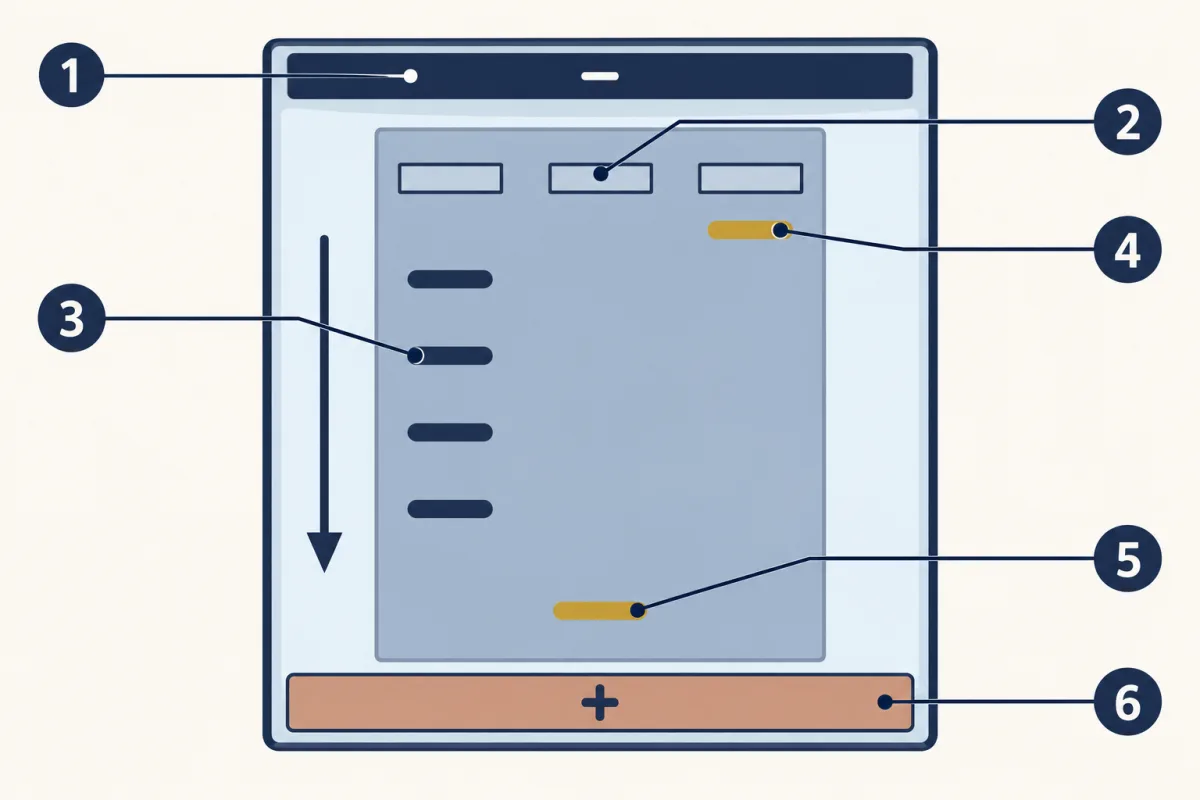
- negative end
- wells
- ladder
- long piece
- short piece
- positive end
- blank
- wells
- ladder
- blank
- blank
- blank
Word bank: long piece, negative end, positive end, short piece
- blank
- blank
- blank
- blank
- blank
- blank
Check your labels
- negative end
- wells
- ladder
- long piece
- short piece
- positive end
Explain: from a human gene to insulin, crops and cures
Here is the textbook path to insulin made by bacteria. It is a simplified model, not a factory recipe.
- Get DNA that codes for insulin. In an early experiment, reported in 1979, scientists made this DNA chemically, as two pieces, one for each of insulin’s two protein chains.
- Cut a plasmid open with a restriction enzyme. Cutting the gene with the same enzyme gives it matching sticky ends.
- Mix them so the ends pair, and seal them with ligase. Now you have recombinant DNA.
- Put the plasmids into bacteria. Only some bacteria take one up. The plasmid usually also carries a gene for resistance to an antibiotic, so growing the bacteria with that antibiotic leaves mostly the ones that took up the plasmid.
- Grow the bacteria. As they divide, the plasmid is copied. If the gene is switched on, the bacteria make the insulin chains, which are collected and purified, and the two chains are then joined into insulin.
Adding a gene does not guarantee the cell makes its protein, so scientists test for the product. You can follow how cells read a gene into a protein in that lesson.
An organism whose DNA was changed this way is a genetically modified organism. Examples come from three fields:
| Field | Example | What was changed |
|---|---|---|
| Medicine | Human insulin; human growth hormone | Bacteria or yeast carry a human gene |
| Medicine | Casgevy, approved in 2023 for sickle cell disease | A patient’s own blood stem cells are edited with CRISPR |
| Agriculture | Bt corn and cotton | A bacterial gene makes a protein that kills certain insect pests |
| Agriculture | Herbicide-tolerant soybeans | Plants survive certain weed-killers |
| Industry | Cheese-making enzyme chymosin | Microbes carry the gene for an enzyme once taken from calf stomachs |
| Research | Edited cells grown in a lab | Scientists switch off one gene to learn its job |
Synthetic biology goes a step further: it designs and builds new biological parts, devices and systems. In one example, researchers built a new chemical pathway in baker’s yeast so that it made a starting material for a malaria medicine.
Each use raises questions that data alone cannot settle. People disagree, and that is part of the work.
- Safety: Could an edit land in the wrong place? Could a crop affect insects it was not meant for? Can relying on one weed-killer select for resistant weeds, as in that lesson?
- Equity: Who can pay for a new treatment? Who can buy the seed?
- Limits: Should anyone edit sperm, eggs or embryos, when future people cannot agree to the change?
To judge a claim, ask who wrote it, what evidence it gives, whether it was checked by other scientists, and whether the writer gains from your belief.
Elaborate: how common are engineered crops?
USDA asks farmers each June what they planted. This table shows the share of planted acres grown with any genetically engineered variety.
| Year | Corn, engineered varieties (% of U.S. planted acres) | Soybeans, engineered varieties (% of U.S. planted acres) |
|---|---|---|
| 2000 | 25 | 54 |
| 2004 | 47 | 85 |
| 2008 | 80 | 92 |
| 2010 | 86 | 93 |
| 2016 | 92 | 94 |
| 2020 | 92 | 94 |
| 2024 | 94 | 96 |
| 2025 | 94 | 96 |
Data are U.S. estimates from the USDA June Agricultural Survey, published by the USDA Economic Research Service (2000 to 2024 and 2025 tables). Virginia is not listed separately. NASS estimated that Virginia farmers planted about 630,000 acres of soybeans and 500,000 acres of corn in 2024.
- Which crop reached 90 percent first, and in which year shown?
- How many percentage points did corn rise from 2000 to 2010? Compare that with 2010 to 2025.
- What does this table not tell you about whether engineered crops are safe or helpful?
Claim, evidence, reasoning
Make a claim that answers the essential question, using this data: what do the data show about how people have used crop engineering, and what would you still need to decide whether its use is wise?
Start with: The data show that engineered crops blank, but deciding whether that is wise also needs blank.
Start with: From 2000 to blank, the share of U.S. corn acres with engineered varieties rose from blank to blank percent, and soybeans rose from blank to blank percent.
Start with: Farmers chose this seed because blank, but a share of acres cannot show blank, so we also need evidence about blank.
Compare with a model answer
People already use crop engineering on most U.S. corn and soybean fields. From 2000 to 2025, engineered corn rose from 25 to 94 percent of planted acres, and soybeans from 54 to 96 percent. Farmers chose this seed, likely for insect protection and easier weed control. The data cannot tell us whether those crops are safe, good for the environment or fair to small farms. They are survey estimates for the whole country, not Virginia, and they count acres, not harm or benefit. To decide, we would need safety studies on each crop, data on resistant weeds and insects, and a discussion of costs.
Saved in this browser only.
Design problem
You put an insulin plasmid into bacteria. Plan how to show that your bacteria took up the plasmid and are making insulin, and which controls you need.
One way to do it
- Groups: bacteria given the insulin plasmid; bacteria given the same plasmid with no insulin DNA (the control); bacteria given nothing.
- Selection: grow all three on plates with the antibiotic. Bacteria given nothing should not grow, which shows the antibiotic works.
- Check the DNA: grow colonies, extract the plasmid, cut it with the restriction enzyme and run a gel. The insulin plasmid should show an extra band of the expected size that the empty plasmid lacks.
- Check the product: test each group for insulin with an antibody test. The empty-plasmid group should give no signal, so a signal can come only from the added DNA.
- Constants: same strain, same temperature, same growth time, same amount of DNA.
- Repeats: test at least three colonies from each group that grows, on three different days.
- Safety: use a harmless lab strain, wear gloves and destroy all cultures afterwards.
Evaluate: check your thinking
Bacteria make human insulin because scientists joined insulin DNA into a plasmid with restriction enzymes and ligase. The bacteria copy that plasmid as they divide and read the gene to make the protein. Related tools now change crops, CRISPR now edits blood stem cells, and each use is judged by its evidence and by people’s values.
Science practices you used: predicting and testing with a model, reading a data table and calculating a change, planning controls, judging the reliability of a source, and weighing benefits, risks and ethics.
How we measure it
Gel electrophoresis
DNA pieces are placed in wells at one end of a gel slab, and an electric current pulls them through it. Shorter pieces travel farther, so comparing bands with a ladder of known sizes tells you roughly how long each piece is.
Polymerase chain reaction (PCR)
Repeated cycles of heating and cooling, with primers and a DNA-copying enzyme, make many copies of one chosen stretch of DNA. Labs use it to get enough DNA to study, test or put into a plasmid.
USDA June Agricultural Survey
Each June, the U.S. Department of Agriculture surveys farmers about what they planted, including whether the seed was genetically engineered. The answers give estimates of the share of planted acres for each crop.
Finish line
Test yourself
8 questions
Practice and MCAT-style, with explained answers.
Next · Lesson 23
Building a Tree of Life
A whale lives in the sea and has a body shaped like a fish, so why do biologists say its closest living relatives are hippos?
Continue →