Life Science · Unit 8: Change over time
Extinction and Survival
Why do some species survive big changes while others disappear? You send a blight, habitat loss or a warmer climate through a model forest, then read real data on the American chestnut in Virginia. Afterwards you can explain how environmental change and genetic variation decide who survives, and make a claim about what could help the chestnut.
Where this lesson sits
- Virginia SOL LS.11 a
- Virginia SOL LS.11 c
- Practices LS.1 a, LS.1 c, LS.1 d, LS.1 e
Essential question: Why do some species survive big changes while others disappear?
-
Life Science (grade 7) LS.11 a, LS.11 c You are here
This lesson
-
Biology
Preview it at high school level
In Biology you will learn how scientists measure natural selection with survival data, such as the share of animals with a trait before and after a strong pressure. You will see why populations make far more young than can ever survive, so that only some of them live to reproduce. You will also learn where new variations come from: mutations, the mixing of chromosomes when sex cells form, and animals or pollen moving between populations. This explains why a population with more genetic variety is more likely to have survivors when a new disease or a big change arrives.
-
Biology II Biology II: Advanced Survey of Biology Topics, BIOII.5 a and b; Ecology, EC.5 c
Preview where it goes next
In Biology II: Advanced Survey of Biology Topics, you name selective pressures such as disease, predators and climate, and measure relative fitness, which compares how many offspring different variants leave. You see why genetically diverse populations are more resilient to new diseases. The Ecology course adds life history patterns: some species make many young with little care, others few young with much care, and survivorship curves show at what ages most members die. These patterns help predict which species recover after a disturbance.
-
College
Watch first Who Survives Depends on Existing Variation · 2:40
A hundred years ago, American chestnut trees were common in parts of Virginia’s Blue Ridge Mountains, and people ate their nuts. Then a fungus arrived from Asia, and by about 1950 it had killed billions of these trees.
Small chestnut sprouts still grow from old roots in Virginia’s forests, then get sick and die back. Why did this species nearly disappear when other trees in the same forests did not? And what could help it come back?
What do you think? Decide before you read.
-
Scientists disagree: A chestnut tree cannot grow resistance because it needs it. Its traits come from its parents. When scientists test young chestnut trees in forests, some groups resist the blight much better than others. Survival depends on inherited differences that are already in the population.
What scientists think
Scientists disagree: A chestnut tree cannot grow resistance because it needs it. Its traits come from its parents. When scientists test young chestnut trees in forests, some groups resist the blight much better than others. Survival depends on inherited differences that are already in the population.
-
Scientists disagree: Species still go extinct. In 2023 the U.S. Fish and Wildlife Service took 21 species off its list of endangered and threatened wildlife because they were judged extinct. Most had not been seen for decades, so 2023 is when the decision was made, not when they died out. Habitat loss, pollution, climate change and invasive species put many living species at risk today.
What scientists think
Scientists disagree: Species still go extinct. In 2023 the U.S. Fish and Wildlife Service took 21 species off its list of endangered and threatened wildlife because they were judged extinct. Most had not been seen for decades, so 2023 is when the decision was made, not when they died out. Habitat loss, pollution, climate change and invasive species put many living species at risk today.
-
Scientists disagree: Forest surveys estimate that millions of small chestnut stems are still alive. But most are sprouts from old roots. Blight keeps killing them back, and few make seeds in the wild. A species is safe only if enough members survive and reproduce.
What scientists think
Scientists disagree: Forest surveys estimate that millions of small chestnut stems are still alive. But most are sprouts from old roots. Blight keeps killing them back, and few make seeds in the wild. A species is safe only if enough members survive and reproduce.
Explore: send a change through a forest
In this model, a forest has 50 trees. Each tree has a hidden level of resistance to harm. You choose how much variation the forest has, which change arrives (a blight, habitat loss or a warmer climate), and how many years to run. Trees that survive make seedlings with their own resistance, and a line graph shows how many trees are left.
none some strong resistance (shown after year 0) died this year cleared ground small tree = new seedling
Solid line = trees in the run you see. Dashed line = average of many sketch runs with these settings.
Made up for this sketch (not measurements): resistance is one trait with three levels, none, some and strong. Low variation: 2 trees have some resistance. High variation: 12 have some and 6 have strong. A tree lives through one year of the blight with a chance of 2, 30 or 80 in 100 (none, some, strong), and through the warmer climate with 30, 70 or 95 in 100. Habitat loss clears one strip of 5 places a year, up to 10 strips, and cleared ground stays empty, whatever a tree’s resistance. Each empty place next to a survivor has a 50 in 100 chance of a seedling that copies that parent and counts as a tree at once. No migration, no new traits, no other species. The forest stands for the whole species.
Rule to keep: a population with more genetic variation is more likely to have survivors that pass on a helpful trait, but only if that trait is already present. This is a sketch of the logic, not a prediction for real chestnuts.
Try this.
- Set low variation and send in the blight. Predict whether the forest will recover or fall to zero. Then run it.
- Keep the blight, but switch to high variation. Predict how the line will change, then test it.
- Keep the blight and high variation. Predict whether three runs with the same settings give the same result. Then check.
- Send in habitat loss with high variation. Predict whether more variation saves the forest, then explain what you see.
Explain: survive, move or die
- migrate
- extinct
- extinction
- habitat loss
- pollution
- climate change
- invasive species
- genetic variation
- resistance
Every environment changes. When a change comes, the members of a population do not all share the same fate.
- Some survive and reproduce. Their offspring inherit their traits.
- Some migrate, which means they move to a new place. A bird can fly away; a rooted tree cannot.
- Some die.
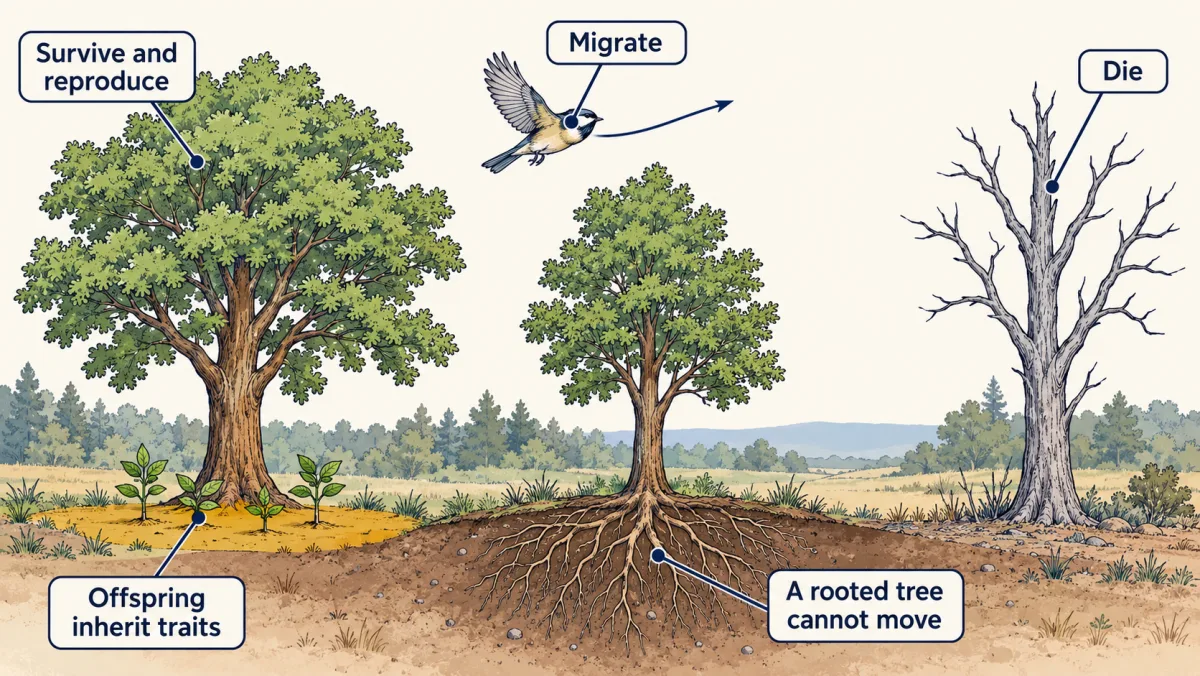
A species is extinct when no living members are left anywhere. Extinction is the dying out of a whole species. Vanishing from one forest is not extinction.
If no member of a species has traits that let it survive a change, the species may become extinct. Natural selection explains why: individuals with helpful traits leave more offspring, as you saw in that lesson. Fossils show that many species went extinct long before people lived, which that lesson explores.
The American chestnut is not extinct. Millions of sprouts still grow from old roots. But the big nut-making trees are gone from most of the canopy, the top layer of leaves in a forest.
Explain: four changes that challenge populations
Four kinds of change put many species at risk today.
- Habitat loss is the destruction of the place where an organism lives. Clearing a forest for houses removes homes for animals that nest in old trees.
- Pollution is harmful material added to air, water or soil. Too much fertilizer washing into a bay can feed algae, and low oxygen for fish can follow.
- Climate change is a long shift in the usual weather of a region, such as warmer average temperatures. Fish that need cold streams may lose places to live as water warms.
- An invasive species is a living thing brought to a new place, where it spreads and causes harm. Blue catfish in Virginia’s rivers are one, as that lesson shows. The chestnut blight fungus is another.
The blight fungus reached North America on chestnut trees brought from Asia. It grows into the bark of an American chestnut and makes a sore called a canker. The canker can kill the whole trunk above the ground. The roots, safe in the soil, often live and send up new sprouts. Then the sprouts get infected and die back, a cycle that can go on for decades.
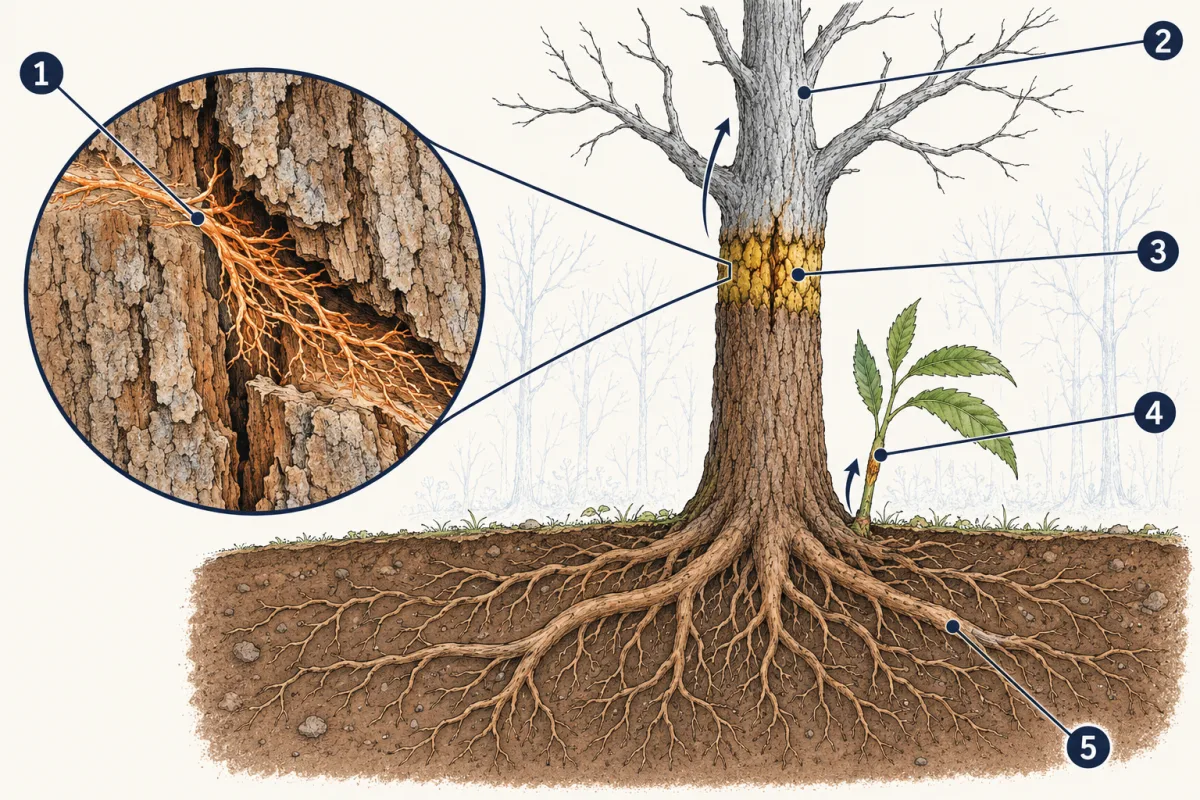
- blight fungus
- dead trunk
- canker
- sprout
- roots
- blank
- blank
- blank
- sprout
- roots
Word bank: blight fungus, canker, dead trunk
- blank
- blank
- blank
- blank
- blank
Check your labels
- blight fungus
- dead trunk
- canker
- sprout
- roots
Explain: why variation matters
Genetic variation is the inherited differences among members of a population. Resistance is the ability to hold off a disease or other threat better than others can. When a new disease arrives, a population with more variation is more likely to have some members that resist it. Those members survive and pass their traits to their offspring.
Variation does not promise survival. The helpful trait usually has to be there already. American chestnuts had very little resistance to this fungus, so almost all of the big trees died. Surviving chestnuts still carry plenty of genetic variation, but American chestnuts as a group resist the blight far less than Chinese chestnuts do.
A few survivors do not make a species safe; they must also reproduce. In a very small population, a trait can disappear by chance if the few members that carry it die before they reproduce.
At research farms in Meadowview, in southwest Virginia, scientists with The American Chestnut Foundation breed chestnuts. They cross American chestnuts with Chinese chestnuts. They test the young trees with blight and breed the most resistant ones again. This is artificial selection: people, not the environment, choose which trees breed. Some scientists have also tried adding one resistance gene to American chestnut trees.
Elaborate: read the chestnut data
| When | What was measured | Value | Unit |
|---|---|---|---|
| Before 1930 | Chestnut share of 719 canopy trees, White Oak Canyon | 15.2 | percent |
| August 1977 | Chestnut share of canopy trees, 10 sites, 100 trees each | 0 | percent |
| June 2021 | Chestnut share of canopy trees, same 10 sites | 0 | percent |
| 1977 | Chestnut sprouts recorded in 20 person-hours of searching | 176 | sprouts |
| 2021 | Chestnut sprouts found in 40 person-hours of searching | 42 | sprouts |
| 2002 to 2012 | Live chestnut stems, eastern U.S. forests (estimate) | 431 | million stems |
Canopy and sprout values: Karban and Karban, PLOS ONE (2024), for White Oak Canyon in Shenandoah National Park, Virginia. The first survey’s exact year is unknown, and the sprout searches used different methods: in 1977 researchers checked 400 sampling points and the 176 is the number of points with a sprout nearby, while in 2021 they counted the sprouts they found. Stem estimate: Dalgleish and colleagues, Forests (2016), using USDA Forest Service plots measured from 2002 to 2012.
| Tree group | Mean rating, North Carolina site (1 to 4 scale) | Mean rating, Virginia site (1 to 4 scale) |
|---|---|---|
| American chestnut | 2.5 | 2.9 |
| Chinese chestnut | 3.9 | 3.9 |
| Hybrid, family D2 | 3.7 | 3.4 |
These ratings come from Clark and colleagues, Forest Ecology and Management (2019). Young trees were planted in forests in 2009 and rated from 2013 to 2016. A score of 1 means the tree was assumed dead from blight, and 4 means no visible disease. The hybrid seedlings, bred from American and Chinese chestnuts, came from the Meadowview farms.
- How did the chestnut share of the canopy change from before 1930 to 1977?
- One person-hour is one person searching for one hour. Divide each sprout count by its person-hours. Which year had fewer sprouts per hour of searching?
- At the Virginia site, how much higher was the hybrid’s rating than the American chestnut’s?
Claim, evidence, reasoning
Make a claim that answers the question: why did the American chestnut nearly disappear, and what could help it survive? Use these data.
Start with: The American chestnut nearly disappeared because blank, and blank could help it survive.
Start with: In White Oak Canyon, chestnut made up blank percent of canopy trees before 1930 and blank percent in 1977. At the Virginia test site, American chestnut rated blank and the hybrid rated blank.
Start with: Trees with little resistance blank, so blank. Breeding can help because blank.
Compare with a model answer
The American chestnut nearly disappeared from the canopy because an invasive fungus killed trees that had little resistance. In White Oak Canyon, chestnut made up 15.2 percent of canopy trees before 1930 and 0 percent in 1977 and 2021. Breeding for resistance could help: at the Virginia site, the hybrid family rated 3.4 and American chestnut 2.9 on a 1 to 4 scale. The data have limits. The canopy data come from one canyon, the ratings use only years 5 to 8 after planting, and in Virginia the American and hybrid ratings were not clearly different in the data (at the North Carolina site they were: 2.5 and 3.7).
Saved in this browser only.
Design problem
Plan a test of whether plants with more variation have more survivors after a hard change. Use garden seeds, not chestnuts.
One way to do it
- Question: After a dry spell, do more seedlings survive in a pot with three radish varieties than in a pot with one variety?
- Independent variable: the number of varieties in a pot (one or three).
- Dependent variable: the number of seedlings still alive after 14 days.
- Constants: 30 seeds per pot, the same soil, pot size, light, and 50 mL of water each time.
- Control: a pot of each kind watered every two days, with no dry spell.
- The change: after the seedlings sprout, water the test pots only once a week.
- Repeated trials: three pots of each kind.
- Also measure: seedling height in centimetres.
- Safety: wash your hands after handling soil, and never taste seeds, since some are coated with chemicals.
More survivors in the mixed pots would support the claim. Different varieties of one plant are only a model of variation.
Evaluate: check your thinking
The American chestnut nearly disappeared because an invasive fungus arrived, and American trees had little resistance to it. Its roots still sprout, so the species is not extinct, but few trees make seeds. Breeding with Chinese chestnuts adds the resistance that the population lacked.
Science practices you used: making predictions and testing them with a model, reading data tables and calculating a rate, making a claim with evidence and reasoning, and naming the limits of a model and of data from one place.
How we measure it
Canopy tree survey
Researchers walk to marked sites and name the species of each tall tree whose leaves reach the top layer of the forest. Counting each species gives its percent of the canopy, and repeating the survey years later shows what changed.
Forest inventory plots
The USDA Forest Service measures trees in many sample plots spread across the country. Scientists use these samples to estimate how many stems of a species grow across a whole region, and how big they are.
Blight rating
Each year, researchers look at every young tree in a test planting and give it a score from 1 (assumed dead from blight) to 4 (no visible signs of disease). Comparing mean scores shows which groups of trees resist the blight better.
Finish line
Test yourself
8 questions
Practice and MCAT-style, with explained answers.
That's the last lesson
Back to all lessons
Pick another topic, or revisit one you want to firm up.
All lessons →