Biology Together · Unit 8: Virginia and Chesapeake nature
Creek Critters
At a shallow, slow creek in a public park, you and your child catch small animals from under rocks with a kitchen strainer, look at them in a white tray, sort them by how they move, and put every one back. Your child finds out that a creek is full of connected life, where small animals eat leaf bits and each other and fish eat them, and that some of those animals are clues to how clean the water is.
Watch first Set Up: Creek Critters · 1:04
Read the transcript of “Set Up: Creek Critters”
Film transcript: Set Up: Creek Critters
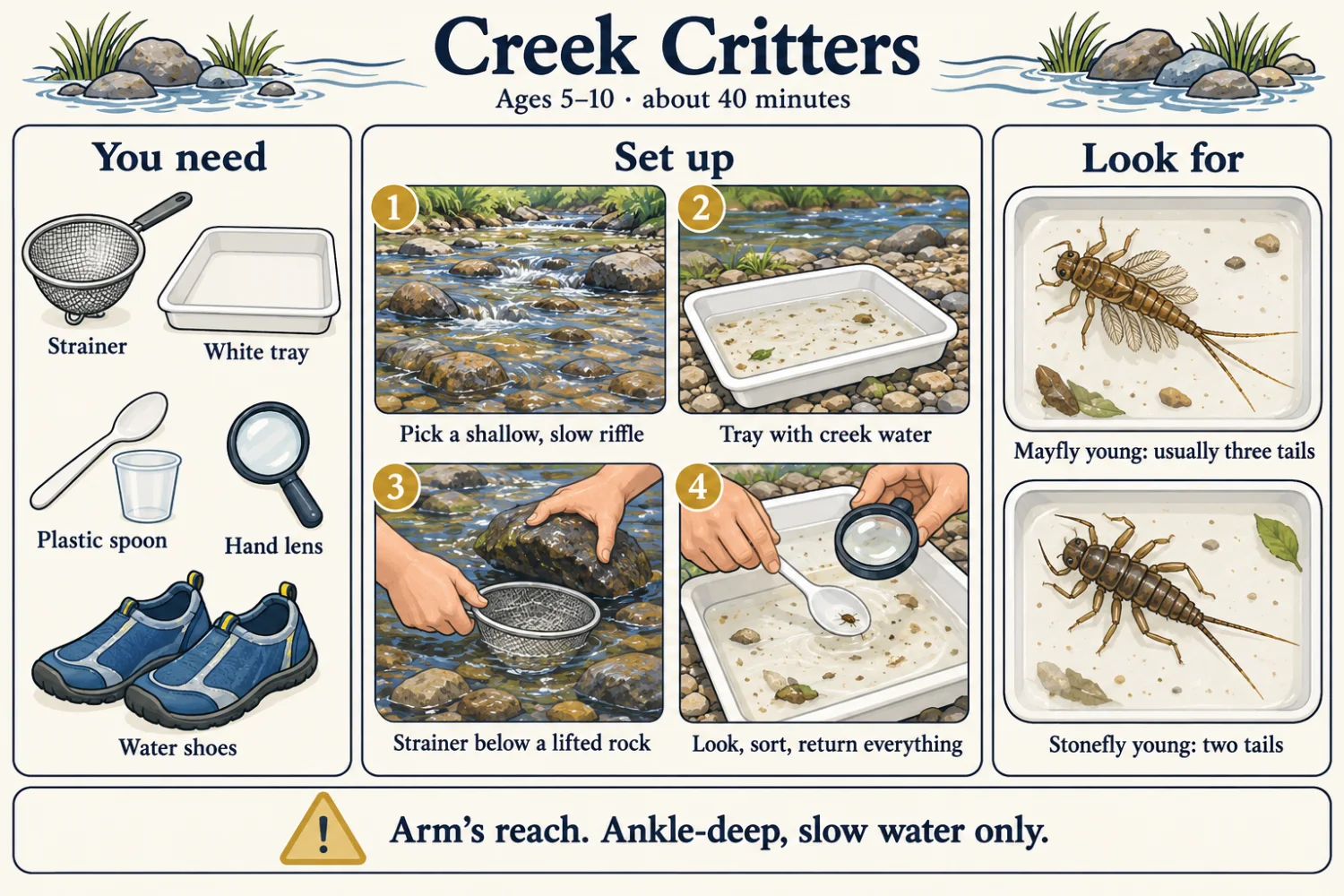
A creek is full of tiny animals hiding under the rocks. They eat bits of leaves, and fish eat them, so they all need each other. Some only live in clean water, so they are clues to how healthy the creek is. You need a kitchen strainer or small net, a white tray, a plastic spoon, and closed toe water shoes for everyone. Pick a creek with a shallow riffle, low and clear, at least three days after heavy rain. Fill the tray with creek water, about two to three centimeters deep. Hold the strainer just downstream of a rock while someone lifts the rock and rubs its underside. Tip the strainer into the tray. After a minute, specks will start to move.
Finding many different kinds is usually a sign of a healthy creek. Stay within arm's reach of your child the whole time they are in or beside the water. Wade only where the water is ankle deep, and slow, never rushing.
Before you start
- Hands-on time
- About 40 minutes, plus checking the creek and the weather a day or two before you go
- Where
- Outdoors
- Ages
- 5 to 10, with an easier and a harder version below
- Grown-up
- Stay within arm’s reach of your child the whole time they are in or beside the water. You choose the spot and decide if the water is safe.
What you need
- A kitchen strainer or small aquarium net
- A white plastic tray, dishpan or large white tub lid
- A plastic spoon and a small clear cup for moving animals
- A hand lens (optional)
- A white ice-cube tray or egg carton for sorting (optional)
- Closed-toe water shoes or old sneakers for everyone
- Soap and a jug of clean water for washing up
- Waterproof bandages, a towel, sunscreen, insect repellent and a hat, and drinking water from home
- A pencil and the printed observation sheet below
Virginia science standards SOL 3.5 aSOL 3.8 aSOL 4.8 aSOL 4.8 bSOL 2.5 aSOL 4.7 c
The big idea
Pick up a rock from a shallow creek and turn it over. Small animals scramble off the bottom of it. Most children have never noticed them, and most adults haven’t either.
A creek is an ecosystem: living things together with the nonliving things they need, such as water, rocks, sunlight and air. Many of the animals under the rocks are the young of insects like mayflies, stoneflies and caddisflies. They live underwater for months or years before they grow wings and fly away. Snails, crayfish and worms live there too.
These animals depend on one another. Many eat bits of fallen leaves and tiny plants, and some eat other small animals. Many fish depend on them for food. They also depend on the water around them.
Because they depend on the water around them, some of these animals can live only in clean water with plenty of oxygen. Others can live in dirtier water. So the mix of animals you find is a clue to the creek’s health. Volunteers with Virginia Save Our Streams sample creeks this way, and the state uses their counts.
What to do
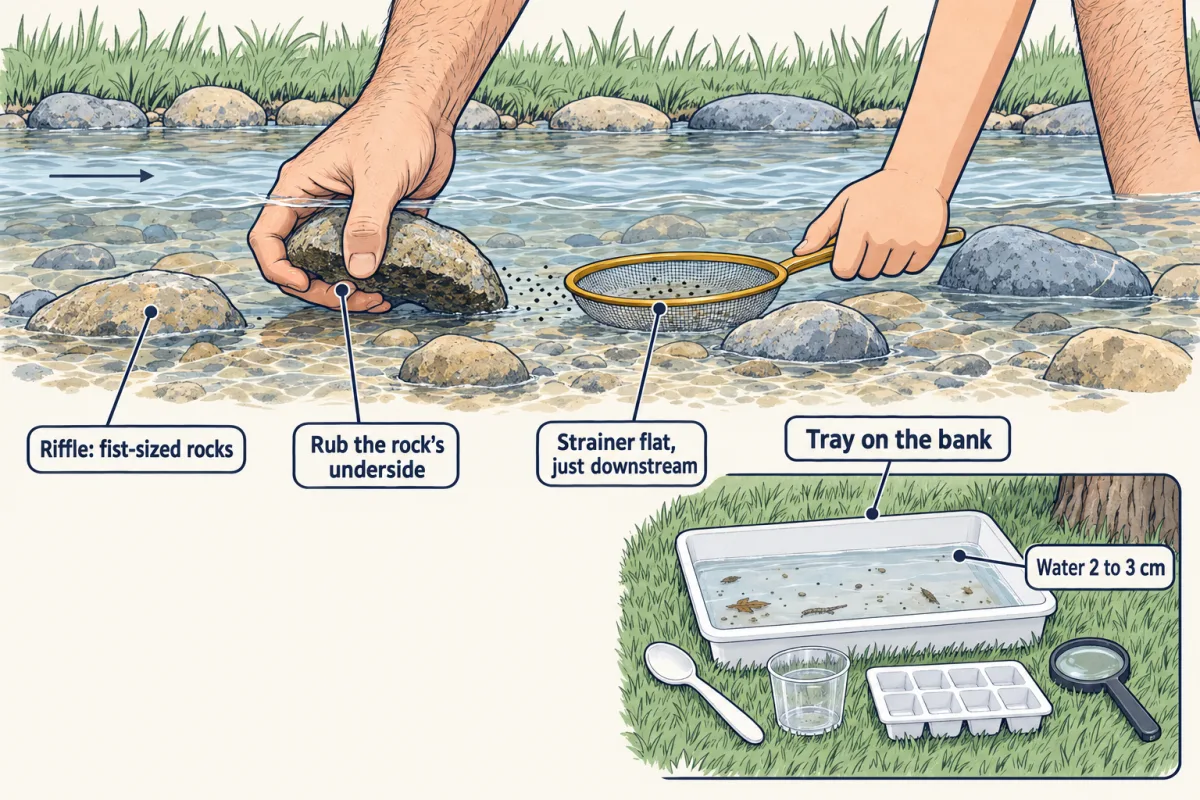
- Choose the spot and the day. Pick a public park creek with a riffle: a shallow stretch where water ripples over fist-sized rocks. Late spring to fall is when the water is warm enough to wade. Some stonefly young are hard to find in midsummer, so finding none then does not mean the creek is unhealthy. Go when the creek is low and clear, at least three days after heavy rain.
- Set up on the bank. Fill the white tray with creek water about 2 to 3 cm deep. Keep it in the shade so the water stays cool.
- Predict. Before anyone touches the water, ask, “What do you think lives in this creek?” Have your child draw their guess.
- Catch. One person holds the strainer flat on the creek bed, just downstream of a rock. The other lifts the rock, looks first for crayfish or hellgrammites, which pinch, and then gently rubs its underside with their hands for about 30 seconds, so loose animals wash into the strainer. Tip the strainer into the tray. Try three or four rocks.
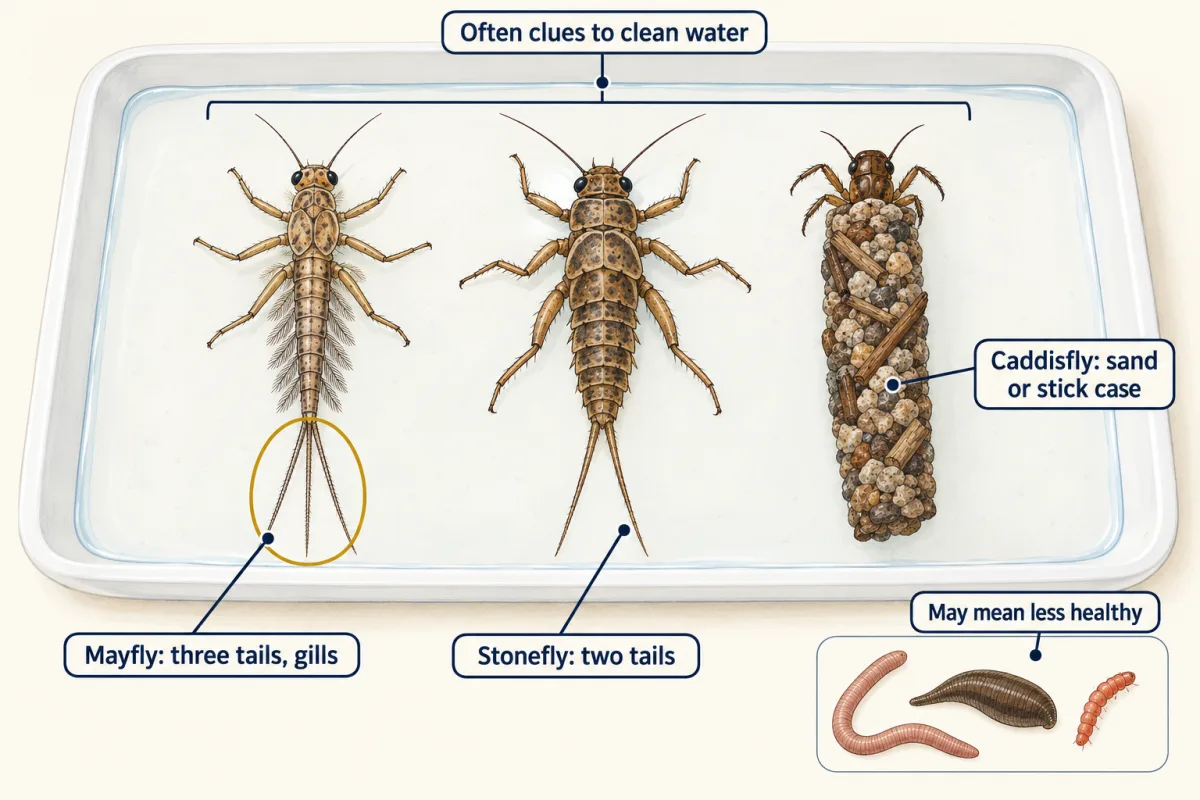
- Look. Wait a minute for the mud to settle. Things that looked like specks will start to move. Use the hand lens. Look for tails, legs and feathery gills. Mayfly young usually have three tails and gills along their sides. Stonefly young have two tails and no gills along the sides of their belly. Caddisfly young often live in little cases made of sand or sticks.
- Sort by how they move. Use the spoon to move animals into the ice-cube tray. Make groups: crawlers and clingers, swimmers, and ones that stay still or stuck to things.
- Read the clues. Ask what each animal eats and what might eat it. Then look at the mix of kinds. Did you find several kinds of mayfly, stonefly or caddisfly young? That is usually a sign of a healthy creek. Kinds differ in how much they can put up with, even within mayflies and caddisflies (see Going deeper), so many kinds tell you more than one. If you found mostly worms, leeches or tiny red wiggly larvae, the water may be less healthy. One visit is a clue, not a final answer.
- Return everything. Pour the tray back slowly at the water’s edge, near where you caught the animals. Put rocks back the way they were. Wash hands with soap.
Questions to ask while you do it
Ask your child to guess first, then check.
- “What do you think we will find under this rock?”
- “I wonder why so many animals live under the rocks and not on top.”
- “What do you think this one eats? How could we find out?”
- “If a fish lived here, which of these animals might it eat?”
- “Can you draw an arrow from what one animal eats to the animal, and then to what eats it?”
- “Which things in the tray are living, and which are not living?”
- “What do you think would happen to these animals if mud from a building site washed into the creek?”
What children often think
-
A child might say “The creek is just water.”
You could try Before you start, ask your child to guess how many animals one rock will hold. Then count together. A creek holds living things like insects, snails and plants, and nonliving things like water, rocks and sunlight. Living things need each other and the nonliving things around them.
-
A child might say “Bugs in the water mean it’s dirty.”
You could try Ask, "Do you think every bug likes the same water?" Then look for mayfly or stonefly young. Many of these insects can live only in clean water, so finding them is good news. Which kinds you find tells you more than how many.
-
A child might say “Fish are the only animals in a creek.”
You could try Ask your child to keep a tally of every animal in the tray that is not a fish. Most creek animals are small, and many hide under rocks, in leaves or in mud. Many fish depend on them for food.
-
A child might say “That worm thing is gross. Let’s squish it.”
You could try Ask, "What do you think it does for the creek?" Creek worms eat bits of dead leaves and mud, and many creek animals break fallen leaves into smaller bits that other animals eat. Each one is part of the creek’s food web, and we are visitors in its home, so we look and then put it back.
Why it works
Scientists call these animals benthic macroinvertebrates: animals without backbones, big enough to see, that live on the bottom. They are useful for judging a stream because they stay in one stretch for months and cannot easily escape pollution. A single water test shows one moment. The animals show what the creek has been like over time.
Most stonefly young, and many mayfly and caddisfly young, need cool water with plenty of dissolved oxygen, which they take in through gills or through their skin. Mud can smother the rocks they live on. Too much fertilizer feeds growth and decay that use up oxygen. Some other pollution harms them directly. Worms, leeches and some midge larvae can live with much less oxygen. A healthy creek usually has many different kinds of animals. A creek with only a few tolerant kinds may have a problem. Sensitivity varies between species within each group, so trained volunteers count and identify carefully before drawing conclusions.
Easier and harder
Ages 5 to 7
Skip naming. Ask your child to sort animals into “has legs” and “no legs,” or “fast” and “slow.” Count the tails on one animal together. Have them draw one creature large on the sheet. Keep the visit to 20 minutes, and let them hold the strainer while you lift the rock.
Ages 8 to 10
Make a tally table with columns for each group: mayflies, stoneflies, caddisflies, worms and leeches, snails, others. Compare two spots, such as a riffle and a slow stretch, or the same spot in two seasons. Wade only where the water is ankle-deep for your child; sample a deeper pool only from a firm, low bank while you stay within arm’s reach, and skip any pool you cannot reach safely. Add a simple key that uses more than one clue: “Does it have three tails or two? Do gills run along the sides of its belly? Does it live in a case?” Some mayflies have only two tails but still have side gills, and damselfly young have three flat, leaf-like tails, so check every clue before you decide. Ask what the counts suggest about the creek, and what else they would want to know.
If it doesn’t go as planned
If you find almost nothing, try a faster, rockier spot, rub the rocks longer, or come back in another season. With no safe creek nearby, try a pond: you collect a cup of water and leaves from the edge while standing on firm ground. Or, with permission, the adult can tie a mesh onion bag of dead leaves to a rock in a riffle and lift it out three to four weeks later, only in water that is ankle-deep and slow, at least three days after heavy rain.
Observation sheet
Observation sheet
Creek critters
NameDate
Draw each animal you find. Count how many. Circle how it moves.
| Animal (draw it) | How many? | Crawls, swims or stays still? | Clean-water clue? (yes or no) |
|---|---|---|---|
Nonliving things in the creek:
I think this creek is:
biochemistrypedia.com · Biology Together
Going deeper
Kinds that live in dirtier water
A few common kinds, such as net-spinner caddisflies and some small mayflies, also live in dirtier water. That is one more reason that finding many kinds tells you more than finding one.
Comparing with the ocean
Virginia’s grade 4 standard groups ocean animals by how they move: floating, swimming, or staying fixed to the bottom. Ask your older child how the groups from step 6 compare to floating, swimming and fixed ocean animals.
Finish line
Test yourself
4 questions
Practice and MCAT-style, with explained answers.
That's the last lesson
Back to all lessons
Pick another topic, or revisit one you want to firm up.
All lessons →