Life Science · Unit 2: Organizing and classifying life
Domains, Kingdoms and DNA
Why are mushrooms no longer grouped with plants, and how can DNA move a living thing to a new group? You sort organisms with four clues, add new kinds of evidence one at a time, and read real protein comparisons for a fungus, a human and two plants. Afterwards you can place organisms in domains and kingdoms and explain why new evidence can change the groups.
Where this lesson sits
- Virginia SOL LS.3 c
- Practices LS.1 c, LS.1 d, LS.1 f
Essential question: Why are mushrooms no longer called plants, and how can DNA change where a living thing belongs?
-
Life Science (grade 7) LS.3 c You are here
This lesson
-
Biology
Preview it at high school level
In Biology you will read the real evidence that created the domain Archaea. In 1977, Carl Woese and George Fox compared ribosomal RNA, a molecule every cell uses, and found that some microbes formed their own line of life. You will learn two new words: prokaryote, a cell with no nucleus, and eukaryote, a cell with a nucleus. You will see how the chemistry of cell walls and cell membranes also separates Archaea from Bacteria. You will meet other groups that DNA has changed, such as African forest and savanna elephants, now counted as two species instead of one.
-
Biology II Biology II: Genetics, GEN.6 e
Preview where it goes next
In the Biology II Genetics course you compare different ways to define a species: by whether organisms can mate and have young that can reproduce, by body form, or by shared ancestry read from genes. You see how genetic makeup is used to classify organisms, especially microbes that do not mate in the usual way. Newer genome studies also suggest that Eukarya branched from within one group of archaea, and you learn why scientists still keep the three domain names.
-
College
Watch first Why Mushrooms Are Not Plants · 2:35
A mushroom pops up on a dead log after rain. It does not walk, swim or fly away. For a long time, many scientists grouped mushrooms with plants. Today they sit in their own kingdom, and DNA shows they are closer to you than to an oak tree. How did that happen?
What do you think? Decide before you read.
-
Scientists disagree: Scientists also compare DNA and proteins. In 1993, two scientists compared 25 proteins in animals, fungi and plants. The results strongly supported fungi being closer to animals than to plants, even though a mushroom looks more like a plant.
What scientists think
Scientists disagree: Scientists also compare DNA and proteins. In 1993, two scientists compared 25 proteins in animals, fungi and plants. The results strongly supported fungi being closer to animals than to plants, even though a mushroom looks more like a plant.
-
Scientists disagree: In 1735, living things were sorted into two kingdoms, plants and animals. Microscopes, cell studies and then comparisons of molecules each added new evidence. By 1990 scientists had proposed three domains above the kingdoms.
What scientists think
Scientists disagree: In 1735, living things were sorted into two kingdoms, plants and animals. Microscopes, cell studies and then comparisons of molecules each added new evidence. By 1990 scientists had proposed three domains above the kingdoms.
-
Scientists disagree: Bacteria and Archaea look alike under a light microscope, and neither has a nucleus. But comparing a molecule that all cells share showed they are very different. Yeast is a microorganism too, and its cells have a nucleus, like yours.
What scientists think
Scientists disagree: Bacteria and Archaea look alike under a light microscope, and neither has a nucleus. But comparing a molecule that all cells share showed they are very different. Yeast is a microorganism too, and its cells have a nucleus, like yours.
Explore: sort living things by evidence
In the model you see six cards: a mushroom, an oak, a deer, a paramecium, a bacterium and an archaeon. A slider adds evidence one kind at a time: what your eyes see, then a light microscope, then cell chemistry, then DNA. The cards move into new groups, and a bar shows how alike one protein is for the pairs the lesson measured.
Protein match (one protein) for the pair you picked
Made up for this sketch: only six organisms; boxes, not branches; the order of the four kinds of evidence; the mushroom, deer and oak stand in for groups the table measured with other organisms; bar values are that table’s means, rounded.
Rule to keep: the more alike two organisms’ DNA sequences are, the more recent their common ancestor, and new evidence can change the groups.
Try this.
- Set the slider to “what eyes see.” Predict which card the mushroom will sit with. Then check.
- Predict what happens to the bacterium and the archaeon when you add the microscope, and then when you add cell chemistry. Test each step.
- Pick the mushroom and the deer, then the mushroom and the oak. Predict which pair has the taller protein bar.
Explain: four clues sort life into domains and kingdoms
- nucleus
- cell wall
- chloroplast
- Bacteria
- Archaea
- Eukarya
- protist
- fungus
- DNA sequence
- common ancestor
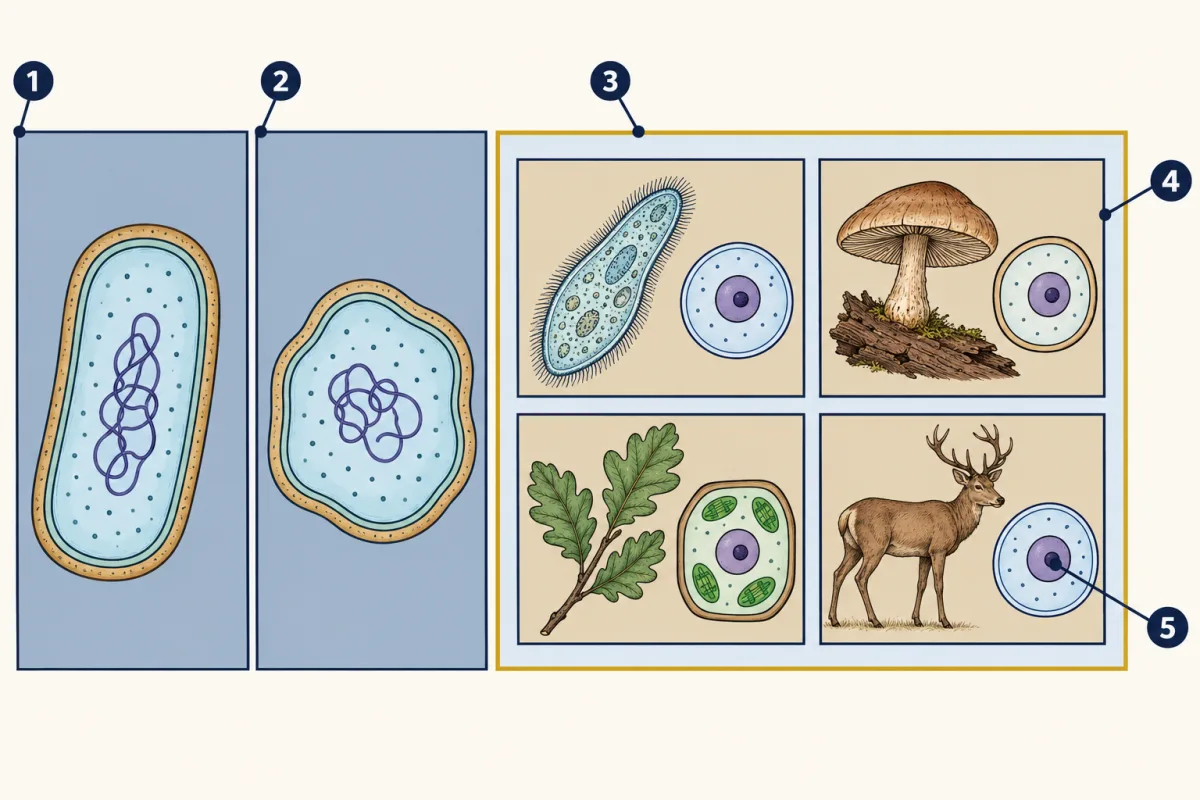
You met the levels of classification, from domain down to species, in that lesson. Here you see how scientists choose an organism’s domain and kingdom. They ask four questions:
- Do its cells have a nucleus? A nucleus is the part of a cell that holds its DNA.
- Which cell parts does it have? A cell wall is a stiff layer outside the cell membrane. A chloroplast is a green part where a cell makes sugar (glucose) using light.
- Does it have one cell or many?
- Does it make its own food, or take food in?
The first question splits life into cells with a nucleus and cells without one. Genes and chemistry then split the cells without a nucleus into two domains, so life has three domains. Bacteria is a domain of tiny, mostly single-celled organisms with no nucleus. Archaea is a second domain of mostly single-celled organisms with no nucleus. Eukarya is the domain of all organisms whose cells have a nucleus.
Bacteria and Archaea look alike under a light microscope. But their chemistry and their genes show they are very different from each other, and from Eukarya.
Many US textbooks then use six kingdoms. Bacteria and Archaea each get one. The other four are inside Eukarya.
| Kingdom | Nucleus? | Cell wall? | Chloroplasts? | Cells | Food |
|---|---|---|---|---|---|
| Bacteria | No | Most have one | No | Mostly one | Some make it, some take it in |
| Archaea | No | Most have one | No | Mostly one | Some make it, some take it in |
| Protists | Yes | Some | Some | Most one, some many | Some make it, some take it in |
| Fungi | Yes | Yes | No | Most many; yeast one | Take it in |
| Plants | Yes | Yes | Yes, in green parts | Many | Make it |
| Animals | Yes | No | No | Many | Take it in |
A protist is an organism with a nucleus that is not a plant, animal or fungus, such as a paramecium. A fungus is an organism with a nucleus and a cell wall but no chloroplasts, which takes in food from what it grows on.
- Bacteria
- Archaea
- Eukarya
- Fungi
- nucleus
- blank
- blank
- Eukarya
- blank
- nucleus
Word bank: Archaea, Bacteria, Fungi
- blank
- blank
- blank
- blank
- blank
Check your labels
- Bacteria
- Archaea
- Eukarya
- Fungi
- nucleus
Explain: new tools bring new evidence
The groups have changed many times, each time after a new kind of evidence.
| Year | Scientist | Groups | New evidence behind it |
|---|---|---|---|
| 1735 | Linnaeus | 2 kingdoms of living things | Body parts seen by eye |
| 1866 | Haeckel | 3 kingdoms | Tiny living things that were neither plant nor animal |
| 1938 | Copeland | 4 kingdoms | Cells with no nucleus put in their own kingdom |
| 1969 | Whittaker | 5 kingdoms | Fungi separated by how they get food |
| 1977 | Woese and Fox | 3 main lines of life | Comparing a molecule all cells have (ribosomal RNA) |
| 1990 | Woese, Kandler and Wheelis | 3 domains | Molecule comparisons; a new level above kingdom |
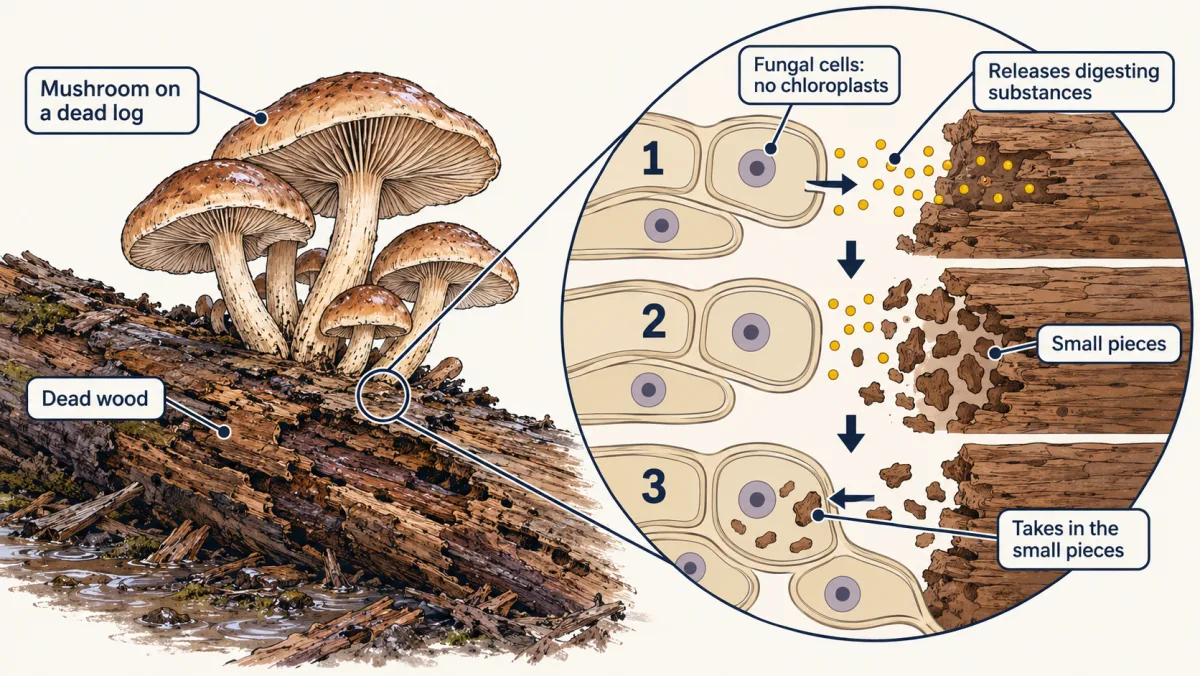
Mushrooms show how this works. Mushrooms stay in one place, like plants. But a closer look showed that fungal cells have no chloroplasts, so fungi cannot make sugar from light. Instead, a fungus releases digesting substances outside its cells and takes in the small pieces. A mushroom on a log feeds on the dead wood. Other fungi feed on living hosts or trade food with living plants.
Then came DNA. A DNA sequence is the order of the chemical letters in a stretch of DNA. Each protein is built from a gene’s instructions, so comparing proteins is another way to compare genes. You will read about DNA in that lesson.
The more alike two organisms’ DNA sequences are, the more closely related they are. A common ancestor is an organism that two groups both descend from. These comparisons put fungi closer to animals than to plants. That does not make a mushroom an animal. It means fungi and animals share a more recent common ancestor than either shares with plants.
Elaborate: compare one protein in five organisms
The table compares one protein, called EF-1 alpha, which all five organisms make. A computer lined up the protein from two organisms at a time and counted the positions that matched.
| Pair compared | Kind of pair | Matching positions (out of positions compared) | Match (%) |
|---|---|---|---|
| Human and baker’s yeast | Animal and fungus | 371 of 460 | 80.7 |
| Human and bread mold | Animal and fungus | 387 of 461 | 83.9 |
| Baker’s yeast and thale cress | Fungus and plant | 339 of 461 | 73.5 |
| Baker’s yeast and wheat | Fungus and plant | 336 of 457 | 73.5 |
| Bread mold and thale cress | Fungus and plant | 342 of 462 | 74.0 |
| Bread mold and wheat | Fungus and plant | 345 of 458 | 75.3 |
| Baker’s yeast and bread mold | Fungus and fungus | 394 of 460 | 85.7 |
| Thale cress and wheat | Plant and plant | 425 of 446 | 95.3 |
Source: protein records from the NCBI Protein database, compared with NCBI’s BLAST program on 23 October 2026 for this course. Thale cress is a small weed used in plant research. These percents are for one protein, not for all of the DNA.
- Find the mean match for the two animal-and-fungus pairs. Then find the mean for the four fungus-and-plant pairs.
- Which is higher, and by about how many percentage points?
- Which pair matches best of all? Why does that make sense?
- The fungi matched the blank more closely than the blank.
- This suggests that fungi share a more recent common ancestor with blank.
- One limit of this data is blank.
Claim, evidence, reasoning
Make a claim that answers the essential question: where do fungi belong, and how can DNA evidence change that? Use the table.
Start with: The data show that fungi are closer to blank than to blank.
Start with: The two animal-and-fungus pairs have a mean match of blank percent, while the four fungus-and-plant pairs have a mean of blank percent.
Start with: A higher match means blank, so fungi share a more recent common ancestor with blank.
Compare with a model answer
Fungi are closer to animals than to plants. The two animal-and-fungus pairs have a mean match of about 82.3 percent. The four fungus-and-plant pairs have a mean of about 74.1 percent. A higher match means the protein is more alike, which suggests a more recent common ancestor. So fungi should not be grouped with plants. One limit: this is one protein from only five organisms, with one animal. Scientists trust the claim more because many other proteins agree.
Saved in this browser only.
Design problem
A fungus takes in food. Does baker’s yeast, a single-celled fungus, need sugar to stay active? Plan a test. Active yeast gives off a gas, carbon dioxide, which you can collect in a balloon.
One way to do it
- Question: Does yeast give off more gas when it has sugar to take in?
- Independent variable: sugar added (0 grams or 10 grams).
- Dependent variable: the distance around the balloon, in centimetres, after 30 minutes.
- Constants: 7 grams of yeast, 100 millilitres of warm tap water, the same size bottle and balloon, the same room.
- Control: the bottle with yeast and water but no sugar.
- Trials: three bottles of each kind; find the mean of each.
- What results mean: larger balloons with sugar show the yeast takes in sugar and breaks it down. Similar balloons would mean sugar made no difference here.
- Safety: use warm tap water, never a flame or stove. Wear goggles, do not taste anything, and wash your hands.
Evaluate: check your thinking
A mushroom stays in one place, but its cells have a nucleus, a cell wall and no chloroplasts, and it takes in food. Those clues put fungi in their own kingdom. DNA and protein comparisons then showed that fungi share a more recent common ancestor with animals than with plants.
Science practices you used: sorting organisms with evidence, reading a data table and finding a mean, making a claim with evidence and naming a limit, and planning a fair test with a control and repeated trials.
How we measure it
Light microscope
A light microscope shows whether a cell has a nucleus, a cell wall or chloroplasts. Scientists use these cell clues to place an organism in a domain and a kingdom.
Sequence comparison on a computer
A computer program lines up the DNA, RNA or protein of two organisms and counts the places that match. More matches suggest a closer relationship, so scientists use the counts to test groups.
Finish line
Test yourself
8 questions
Practice and MCAT-style, with explained answers.
Next · Lesson 9
Photosynthesis Feeds the World
How can a seed that weighs, on average, less than a tenth of a gram grow into a tree with thousands of kilograms of wood, while the ground under it does not seem to shrink?
Continue →